
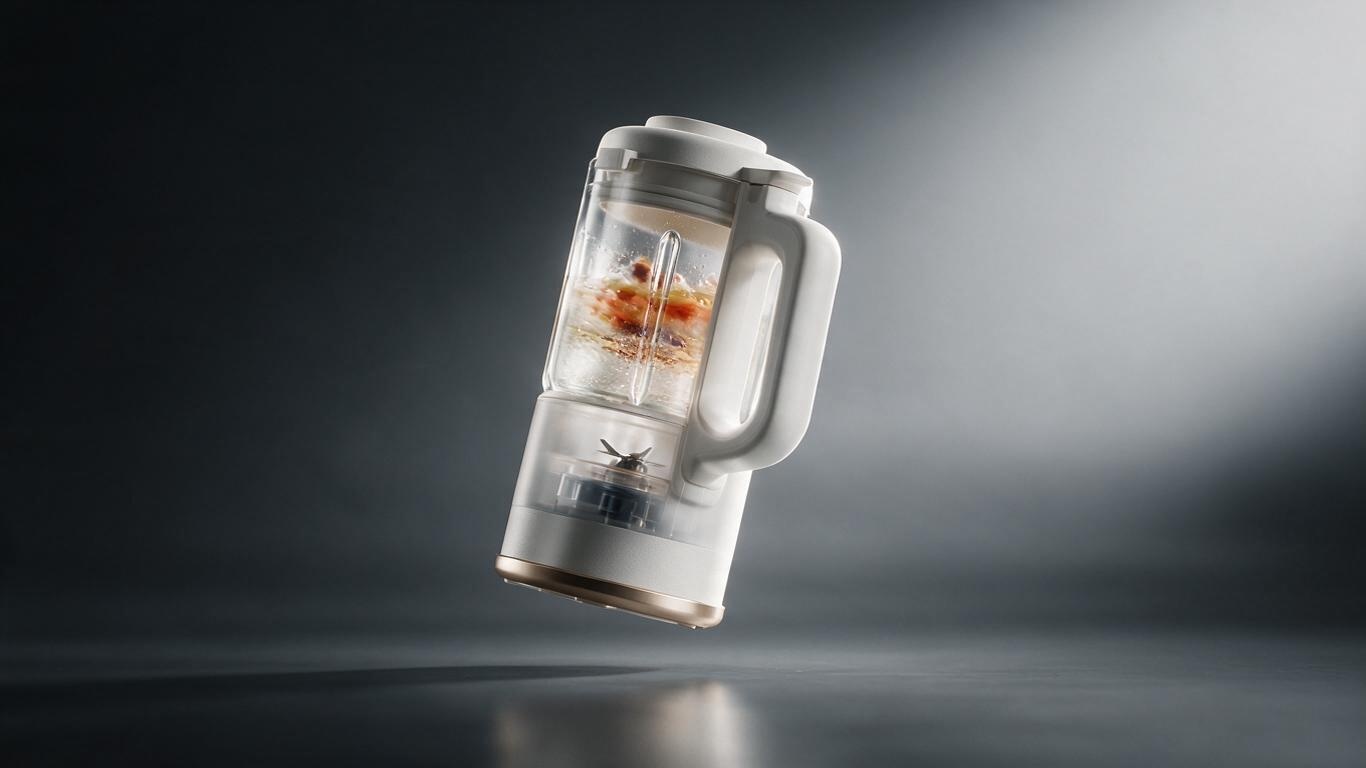
If someone asks you "what is product animation," the quick answer is usually: it's a video that makes a product move. True, but only half the story. Strictly speaking, product animation is imagery in which the product itself is the sole protagonist, generated through 3D modeling and animation technology — it doesn't rely on live shooting, and every rotation, exploded view or material shift is determined by parameters and keyframes.
Put another way: live action records what happened to a product. Product animation designs how a product should be seen. That distinction is exactly why it has become almost irreplaceable on e-commerce detail pages, crowdfunding campaigns and trade-show screens.
In 2026, search interest in the term keeps climbing. The reason is simple: now that every brand can shoot 4K on a phone, being able to film is no longer a competitive edge — being able to explain clearly is.
Drawing the boundary: what it is not
People constantly confuse product animation with three other things, and that confusion leads them astray at the quoting stage.
It is not a 3D still render. A render is frozen; one image carries one selling point. Product animation is the art of time — in 30 seconds it can deliver structure, material, use case and brand mood. The still is a business card; the animation is a self-introduction.
It is not live-action footage with VFX layered on top. Live action is limited by the physical world: your machine tool is too heavy, your drink needs a specific cling effect on glass, your new product exists only as an industrial design drawing. Product animation starts from a model, not a camera.
It is not motion graphics. In motion graphics the stars are type, icons and layout, with the product as a supporting player. Product animation flips that: the product is the absolute center, and every camera move, light and beat serves it.
Three mainstream types, three different business goals
In our project archive we sort client needs into three buckets, and the deciding factor isn't budget — it's the problem being solved.
- Functional demonstration: the goal is comprehension. Best for machinery, appliances and tools. Typical techniques are cross-sections, exploded views and internal highlighting, so a two-ton CNC machine becomes understandable in 20 seconds. We broke down the whole logic in how a precision CNC machine's AI+3D product animation was made.
- Emotional atmosphere: the goal is desire. Best for beauty, accessories and food & beverage. The product rotates slowly in controlled light, a droplet falls at one-eighth speed — you're not selling specs, you're selling want.
- Structural explanation: the goal is trust. Best for 3C electronics, auto parts and baby products. Cutaways, X-ray looks and transparency prove that the inside really looks like that — especially effective for high-ticket items.
A single film can carry two of these qualities, but it must have one primary goal. When priorities blur, all three usually end up under-delivered.
Why brands are moving away from live action only
It isn't that live action is bad — it's that its marginal cost is brutal. Change a color and you reshoot. Change a set and you rebuild. And once the product iterates, the footage is obsolete.
Product animation has a completely different cost structure: modeling is a one-time investment, and after that, recoloring, repackaging and cutting different durations are essentially parameter changes. We compared the two directly, and for the same product across five channel versions (detail page, TikTok, Amazon main image video, trade-show loop, crowdfunding page), the total animation cost came in below multiple live-action reshoots. The full cost table is in from live action to AI+3D: how the product animation workflow evolved.
Controllability matters even more. You cannot make real water splash in a perfect arc within half a second — but you can make the model peak at frame 37.
A practical checklist: is this animation actually any good?
Judging a film by "it looks nice" is the easiest way to get burned. We suggest clients run four tests:
One: do the proportions and details survive magnification? Pause on any frame, zoom to 200%, and check seams, chamfers and texture. Cheap work looks fine in motion but falls apart the moment it stops.
Two: is the lighting logic consistent? Key light direction, environmental reflections and shadow softness should hold steady throughout. When light sources jump around, viewers can't articulate what's wrong — they just stop trusting it.
Three: does the first three seconds deliver information? In short-video contexts, patience is measured in seconds. The product or the core tension must appear immediately.
Four: can it be reused? A competent animation can be cut into 6-second, 15-second and 30-second versions, and its key frames exported as detail-page stills. If it only works once, the value is thin.
Three common misconceptions
The first is that more spectacle equals better. We've seen plenty of films where the product enters through an explosion of particles — and viewers remember the particles, not the product.
The second is waiting until the product is finalized. In reality, starting animation work while tooling is still being developed often shortens the timeline, because the model evolves alongside the industrial design.
The third is chasing the lowest quote. Low prices usually mean downgraded model precision, texture maps used as a shortcut, and reduced render sampling. It might pass on a phone screen, but on a trade-show display it's a disaster. There's a longer list in 5 pitfalls most brands hit with product animation.
When product animation is worth it
Three signals: the product's structure is complex or invisible to the eye (internal mechanisms, material behavior); the product doesn't exist yet or is hard to shoot (crowdfunding stage, oversized equipment); or one product needs to cover multiple channels, languages and formats.
Meet any one of these and the ROI on product animation typically beats live action. Meet all three and it's barely a decision.
So back to the original question — what is product animation? It isn't a video format. It's a way of taking back control over how your product is explained. Once you decide what viewers see at second three and from which angle they understand it, marketing stops being a gamble and becomes a design.
Want to know which type fits your product? Get in touch with us with a product image, and we'll come back within 24 hours with a type recommendation and a timeline estimate.