
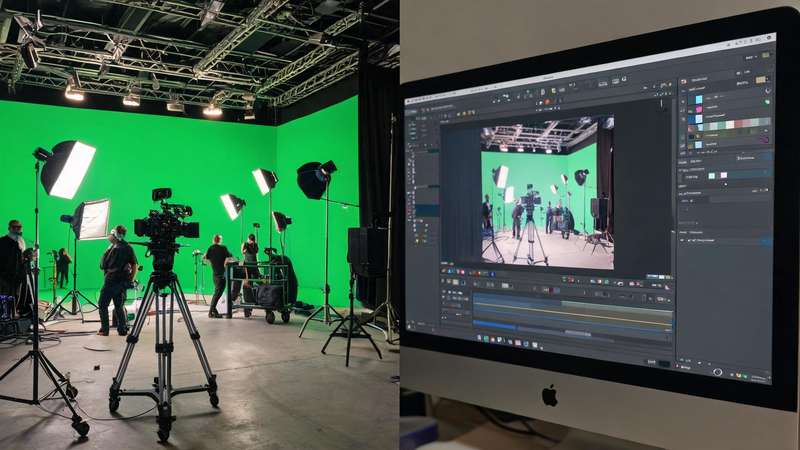
Two Worlds, One Goal

Are you struggling with the budget for product videos? On one side, live-action teams quote tens of thousands; on the other, AI+3D sounds like some vague new tech. Today, we lay out two workflows—traditional live-action vs. AI+3D product animation—and examine where they differ and which path suits your product better.
Traditional Live Production: Familiar but Not Always Optimal

When people think of live-action, they picture sets, lights, photographers, models, post-production editing... This workflow has been mature since the film era. For a 30-second e-commerce product video, from creative script to location scouting, studio rental, set building, shooting, color grading, and editing, it takes at least 5-7 working days. If outdoor scenes or special props are involved, two weeks is common. Cost? A decent live-action team (photography + lighting + art + post) starts at $3,000-$5,000. Add some model fees or sophisticated storyboards, and you're looking at $7,000+. And there's a hard truth: changes mean reshooting. The client wants a different color? Sorry, rebuild the lighting and reshoot. That's why many brands get exhausted after one video.
AI+3D: A Different Approach from Zero to One

Now look at the AI+3D workflow. When a request comes in, the first step isn't finding a photographer—it's modeling. You can use photogrammetry, AI generation (check out our previous article on AI-Generated 3D Modeling Workflow), or directly import the client's CAD file. After modeling, you set up the virtual scene, light, and materials, then use AI-driven motion or manual keyframes (see AI-Driven Motion Generation). Rendering a 1080p video on an RTX 4090 takes about 3-5 hours; 4K might double that. But the big advantage: modification costs are minimal. Change color? Adjust material? Tweak lighting? Just drag and drop in software, then re-render. Timewise, a skilled team can produce a first draft in one day and deliver the final in three days. Cost? At the same quality level, AI+3D is roughly 1/3 to 1/2 of live-action.
The Truth of Comparison: Not Replacement, but Fit
I've seen many brands say, 'I want live-action because it looks real.' But honestly, when your products are electronics, mechanical parts, or transparent-skincare bottles, AI+3D's rendering accuracy and lighting realism surpass live-action—because 3D can achieve physically based ray tracing, while live-action is constrained by real environments. Conversely, if there are real human interaction scenes requiring model emotions, live-action still reigns. So when deciding, break down requirements: Is the product itself the focus? Do you need multiple angles? Will you frequently change color/versions? If yes, AI+3D is a no-brainer.
Ultimately, tools are just means; the core is making products shine on screen. The choice is yours, but data doesn't lie—by 2026, over 60% of top Amazon sellers have switched their main product videos to AI+3D workflows. When are you going to give it a try?