Some things a camera simply cannot show
Late last year a car fridge manufacturer from Ningbo walked into our studio with a hard drive full of footage. Their new dual-zone fridge was about to launch on a crowdfunding page. The live-action crew had spent three days shooting inside cars, in a packed trunk, and at a campsite — and the result was still flat. The fridge just sat there. Where the compressor lives, how the cold air travels, how long it holds temperature after unplugging: none of the questions that actually drive a purchase were answered by a single frame.
That is where this 3d product animation case study begins — a product with a complex internal structure, selling points hidden inside a metal box, and a live-action brief that was basically unsolvable. It is also the most common shape of request we get in 3d animation production: the product has no natural performance. It does not glow, spin, or splash. All of its persuasion is behind the shell.
We have written before about how live action and 3D divide the work. This time we will walk through the same idea with one concrete product, which usually makes it click.
Three visual moves, nothing more
The film runs 30 seconds and uses exactly three visual devices. No decorative camera sweeps, no gratuitous particles.
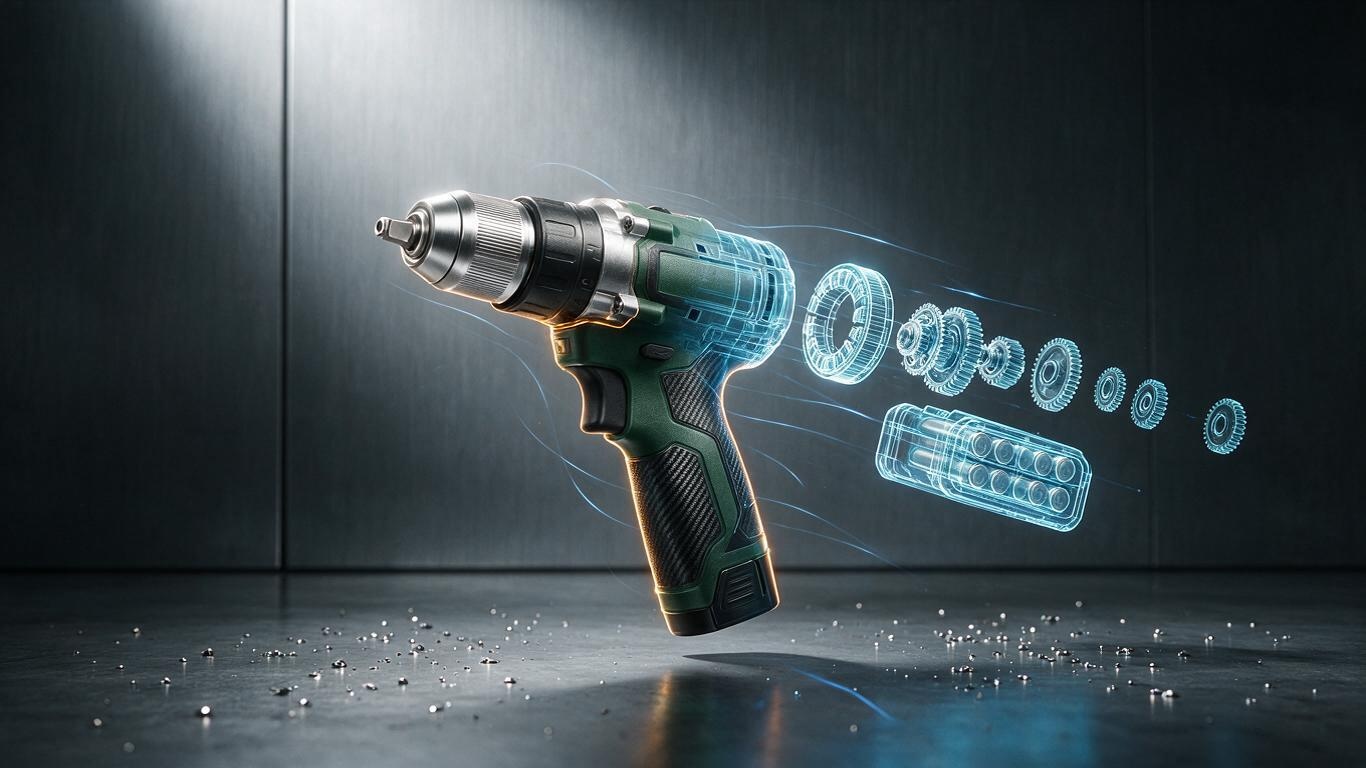
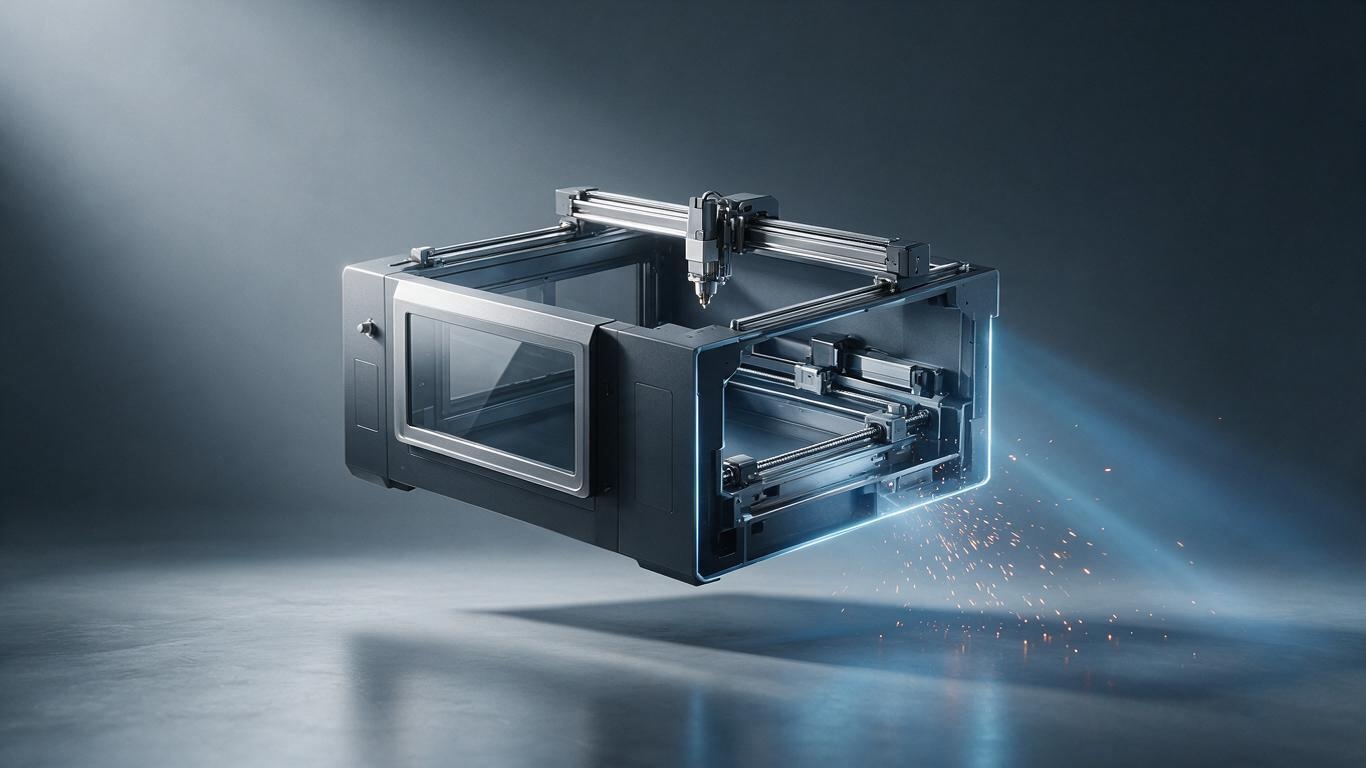
Move one: the cutaway. We slice the body along its centre axis. The shell drops back to a translucent grey silhouette, and the compressor, condenser coil and evaporator emerge in sequence. Refrigerant flow is drawn as a slow particle stream — out of the compressor, through the condenser, past the expansion valve, back to the evaporator. Viewers do not need thermodynamics. They just need to see that the machine is genuinely cooling, not just wearing a blue icon.
Move two: the exploded view. Outer shell, PU insulation layer, inner liner and sealing gasket separate vertically, float, then click back together. This segment answers the single most asked question: how long does it hold cold after the power is cut? The answer is not the compressor. It is insulation thickness and seal design. Ten lines of body copy cannot do what four floating parts do in three seconds.
Move three: scene compositing. We rebuilt three real usage contexts from HDR environments: the passenger footwell of an SUV, a fully loaded trunk, and gravel outside a camping tent. Contact shadows, reflections and cast shadows are all physically computed. Nothing about it reads as CGI. This is also the part of 3D that feels almost unfair compared with a photo shoot — no waiting for weather, no rented vehicle, no clearing the junk out of the trunk.
Seven formats in seven working days
The client handed over STEP files, which saved us most of the modelling time. But CAD geometry cannot go straight into an animation: screw holes, chamfers and internal redundancy need cleaning, polygon counts need reducing, UVs need rebuilding. We covered that pipeline in our piece on the AI-assisted 3D modelling workflow. Two things were added for this project.
First, surface character. The shell is matte dark grey, the insulation cross-section is a coarse foam structure, the gasket is grainy rubber. The contrast between those three surfaces is what makes or breaks the credibility of a cutaway shot. We used AI-assisted generation for the micro-texture of foam and rubber, then hand-tuned the roughness values. Roughly twice as fast as pure manual texturing.
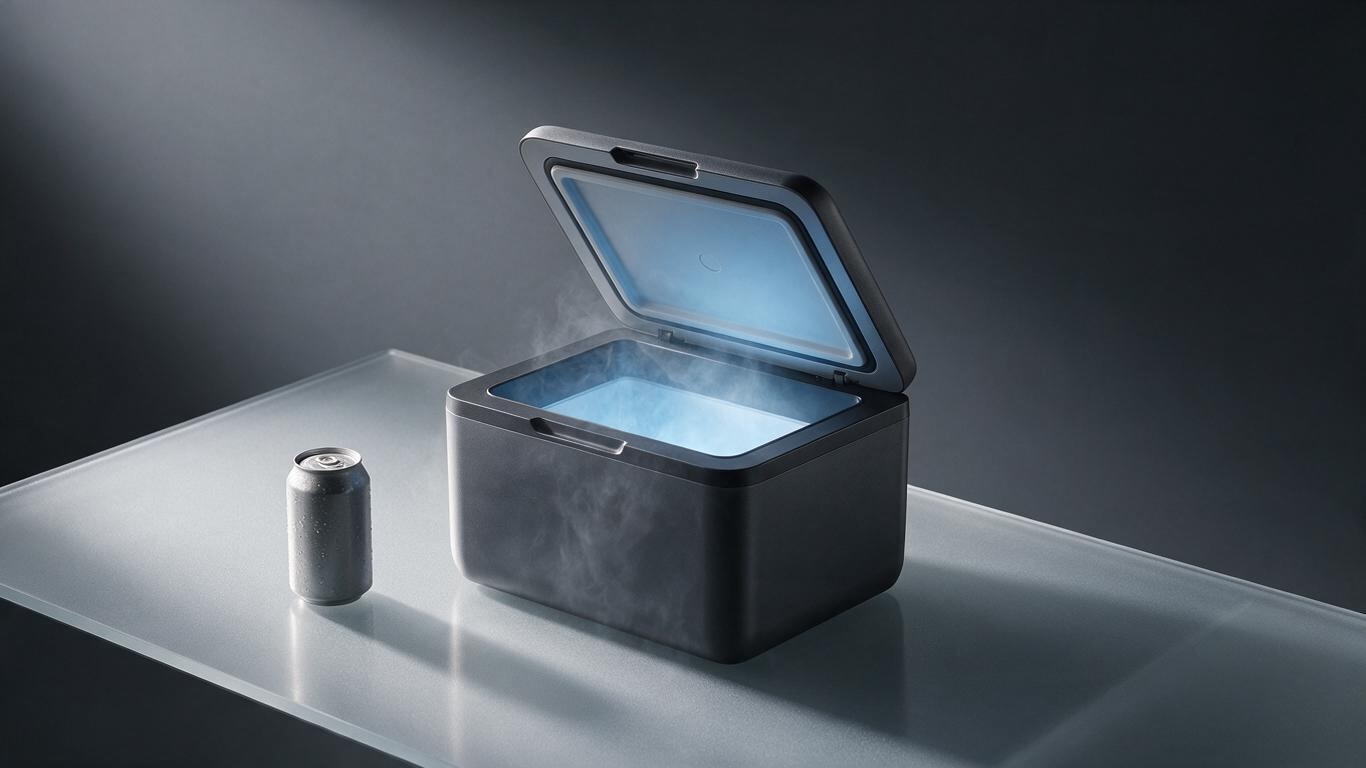
Second, cold air. Cold air sinking cannot be faked with opacity sliders. We ran a volumetric simulation with particle descent, so the chilled air falls slowly from the vent, pools at the bottom of the compartment and spills over the lip. It occupies two seconds of the final film and it is the shot clients mention most often.
Delivery was seven versions in one go: 30-second landscape, 15-second feed cut, 9:16 vertical, 1:1 square, a silent looping version for trade show screens, plus English-subtitled and German-subtitled variants. Seven working days, all assets out the door. The equivalent scope through a traditional pipeline usually runs three to four weeks.
The numbers came from the client, not from us
After launch, the client sent back screenshots from their own dashboard. Completion rate on the 30-second hero film passed sixty percent on the campaign page, noticeably higher than the live-action film used for the previous generation. Average time on the product page moved from around forty seconds to nearly two minutes. Support tickets also changed shape — questions like "how long does it hold cold" and "how do I switch zones" dropped off, which took real pressure off the service team. The campaign's final funding total is not ours to publish, so we will leave the number out.
What interested us more was what happened next. The client recut the 9:16 vertical version and ran it on short-video channels for two weeks; its organic view count beat anything they had run before. Explaining structure well travels across every channel.
What you can steal from this case
- Find the invisible part first. Every product has a core a camera cannot reach: internal structure, working principle, extreme conditions. That is where 3D belongs — not on another orbit around the exterior.
- Stay under three visual moves. Five selling points in 30 seconds means the viewer remembers none of them. Cutaway, exploded view, scene. That is enough.
- Build once, distribute everywhere. Landscape for the site and campaign page, vertical for social, square for feed ads, silent loop for the trade show screen. Design the composition for multiple ratios during production, not after delivery.
If your product is the "looks best when opened up" type — industrial machinery, automotive accessories, small appliances, outdoor gear — our precision CNC machine animation case follows the same playbook. To talk through how your product should be taken apart, contact us and send drawings or product photos. We will tell you straight which parts deserve 3D.