
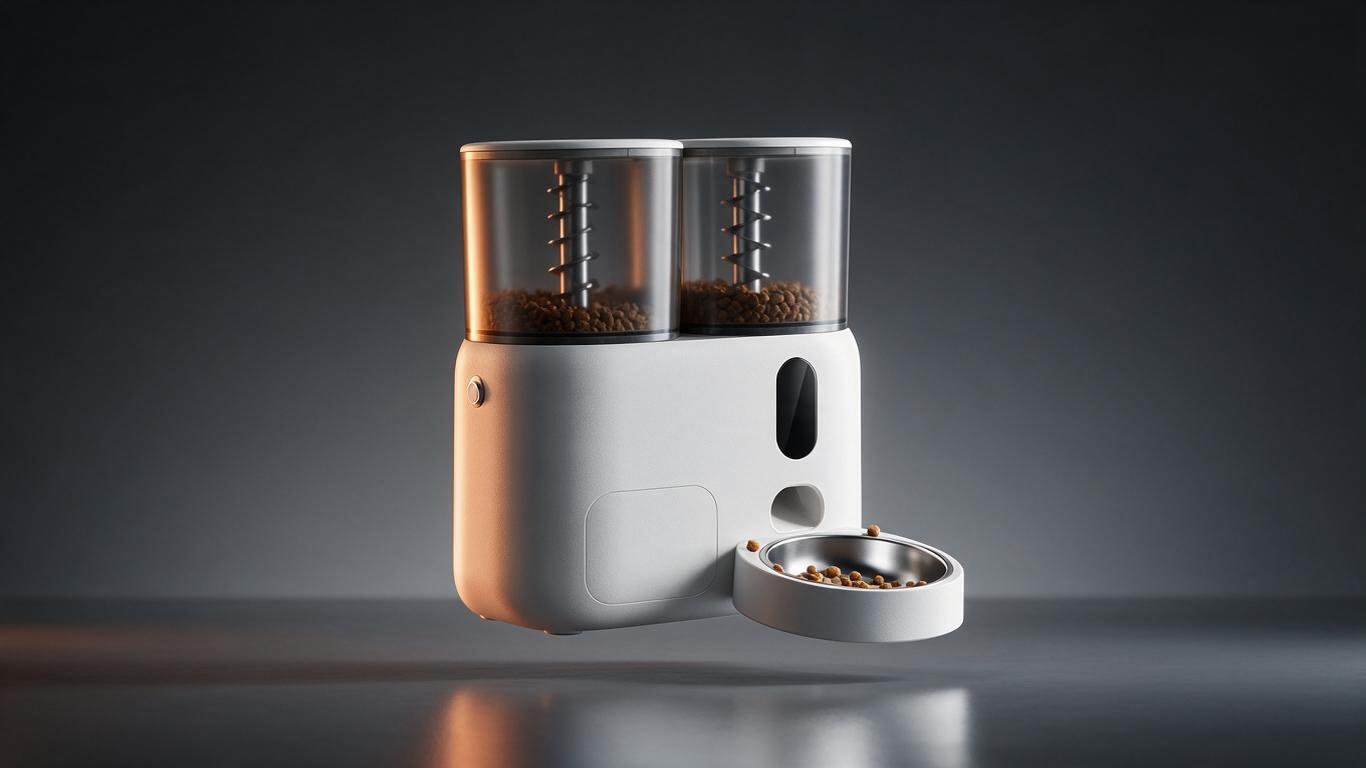
On an April afternoon in Longhua, Shenzhen, a founder slid his laptop across the table. On screen: a thirty-second live-action clip of an automatic pet feeder rotating slowly against a white background. “It's been live for three months,” he said. “Average watch time is six seconds.”
We've reviewed dozens of ecommerce projects since, and the pattern repeats. Most first-attempt product videos don't fail on image quality — they fail on tempo. Viewers don't know what they're supposed to look at in second three. That's why this pet-tech project belongs in any serious collection of ecommerce product animation examples: the problem was never polish, it was unanswered questions.
Here's the full teardown — brief, storyboard, technical build, and the numbers from 60 days live. Including the version that flopped.
The brief: a feeder buyers couldn't see inside
The product wasn't simple: dual hoppers, an anti-jam auger, a removable stainless bowl, 4L capacity, app-scheduled feeding, and a built-in camera. It retailed at $89 on one promise — less worry.
Live action couldn't carry that promise. The three fears that drive returns — jamming, hard-to-clean parts, a nervous cat — all live inside the housing. The anti-jam mechanism is an auger paired with infrared detection, which on camera just looks like kibble falling through a gap. And with five colorways, shooting live meant five separate setups, five lighting passes, five shoot days.
The ask: one 30-second film that could run in the Amazon A+ module, autoplay on the brand's homepage, and loop at a trade show booth. No voiceover reading spec sheets.
Three shots, and every flourish cut
The storyboard came together fast. Convincing the client to drop the opening logo took longer.
Shot one — the cutaway. The hopper splits down the middle, kibble travels along the auger helix at a constant rate, and the frame holds for a beat as it crosses the infrared sensor. The anti-jam logic, explained in one second. This is the hook, running from 0:00 to 0:04. Our AI-assisted 3D modeling workflow compressed the build from two weeks to three days: the client supplied STEP files plus reference photos, we ran AI-assisted reconstruction, then hand-retopologized the critical surfaces so chamfers and button seams stayed accurate.
Shot two — context. Morning light on kitchen tile, the unit running quietly, a ragdoll cat wandering over to eat. Cut to the owner's phone: “2 feedings today.” No face, just a hand — in testing, a full human figure pulled attention away from the product.
Shot three — maintenance. Bowl lifts out one-handed, hopper twists to unlock, rinse, reassemble. Six seconds. It's the least glamorous section and it generated the most positive comments. Buyers don't want beauty. They want certainty.
What the numbers did after launch
The film went live in mid-May 2026. Over 60 days: mobile autoplay completion rose from 27% to 58%; average detail-page dwell time went from 48 seconds to 2 minutes 14; add-to-cart moved from 3.1% to 7.4%. Returns on the hero SKU fell from 9.2% to 5.6%, with “not as described” reasons cut nearly in half.
Support saw the clearest shift: tickets about hopper size, washing, and jamming dropped roughly 31%. The brand's ops lead put it well — “this film saved us half a support hire.”
One caveat: that's a single SKU. We never promise numbers. What we do promise is ranking the buyer's questions by how often they get asked, then answering them one shot at a time.
The version we threw away
The first cut opened with a metallic logo fading in over four seconds of moody lighting, followed by a slow 360 spin.
We put both versions in front of 20 target buyers. Eleven scrolled past the first cut within five seconds; the feedback clustered around “I don't know what this is.” With the cutaway moved to the front, 17 of 20 stayed past the 15-second mark.
That lesson is now part of our internal method: the first second of an ecommerce film isn't for the brand, it's for the question. We catalogued this and related mistakes in 5 common product animation pitfalls — the usual culprit is a creator's perspective overriding the buyer's.
Four things worth copying
- Use your support inbox as a storyboard. Sort the last three months of questions and complaints by frequency. The top five become your first five shots.
- Cutaways and exploded views solve most confusion. Especially for structural products — what a camera can't reach, animation can.
- No logo in the first 3 seconds. Product on screen by second 5. We have yet to find an exception.
- Cut one film into channel-specific versions. The 30-second master for A+ and the site, the 6-second cutaway for short-form, the 3-second maintenance clip for paid feeds.
Short-form product storytelling has shifted fast in recent years — from 30-second ads to a three-second fight for attention. We wrote about that separately in the short-video product showcase revolution.
Last note
Nine working days: one 30-second master, three 6-second cuts, and five colorway still renders. The client has since added two more SKUs.
If you're sitting on a product that live action can't explain, get in touch and bring your support ticket list. We can usually tell you within half an hour which second the film should start on.