
Why a headlight never looks right on camera
In May 2026 an automotive lighting manufacturer opened our first call with a blunt question: “We’ve shot three live-action videos, and buyers at trade shows still ask the same thing — what makes your lamp better than the next one?” It isn’t a filming problem. The selling points of an LED headlight live inside the beam cutoff, the projection lens, the heat-sink fins and the sealed housing — places a camera can’t reach and a spec sheet can’t explain. Twenty-one days later we delivered a 2:40 AI+3D film. This product animation outsourcing case walks through every decision we made.
The client sells to OEMs domestically and to aftermarket distributors overseas. At a trade show, a salesperson gets maybe 30 seconds of attention to explain “more accurate beam, faster cooling, longer life.” Their old assets were a white-background photo set, some factory footage and a noisy legacy promo. Buyers — many of them engineers — flipped past all of it. For them, product animation outsourcing was never about making something pretty; it was about translating specifications into pictures that survive a 30-second glance.
Why not build an in-house team? They ran the numbers: a production-grade 3D artist starts at roughly RMB 20,000 a month, and once you add modeling, materials, render farms and voiceover you’re past RMB 700,000 a year — with no guarantee they stay. A mid-sized outsourced project runs three to five weeks and costs a fraction of that. In almost every product animation outsourcing case we’ve handled, the real value isn’t headcount saved; it’s the process and the pattern library you get to reuse.
Turning a beam pattern into something you can see
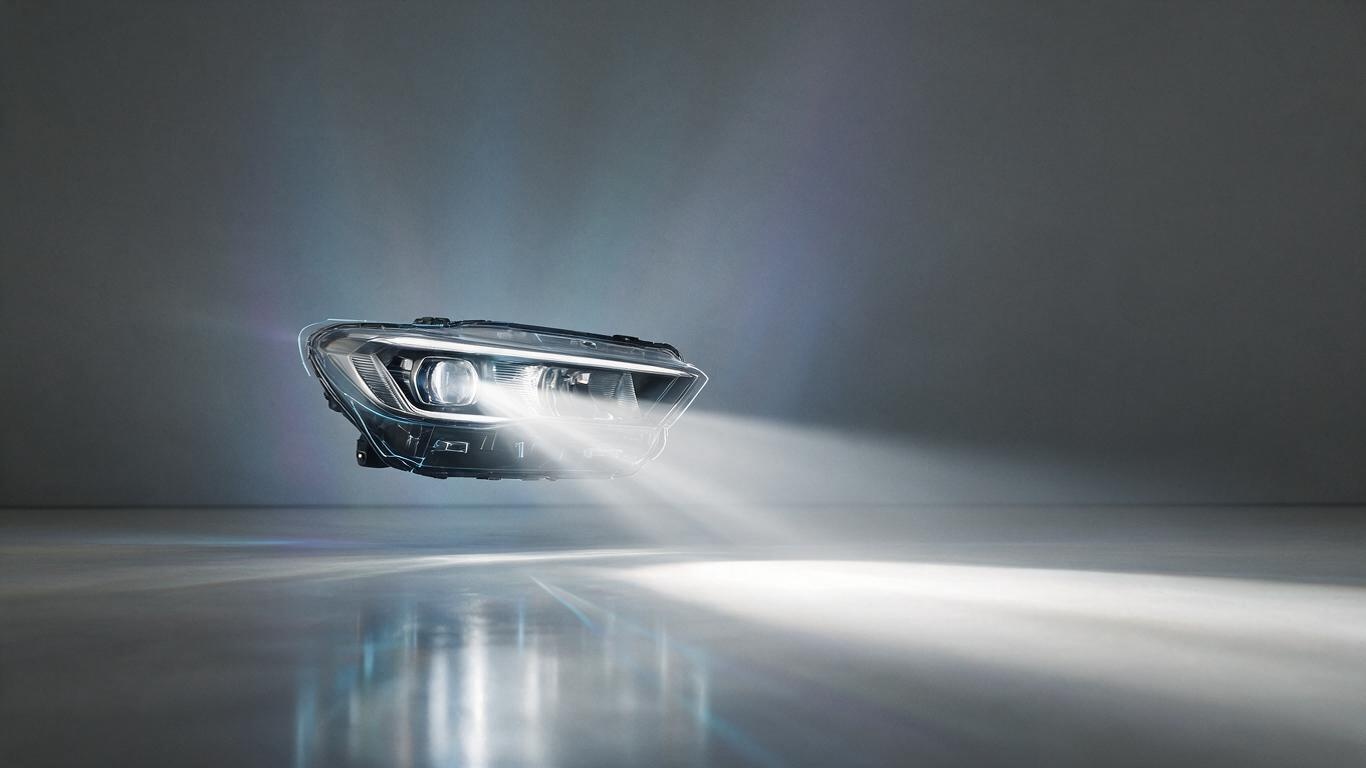
The hard part of a headlight film isn’t making it look good — it’s making an engineer nod. We built three narrative tracks. Light: volumetric beams and ground pools of light to show the low-beam cutoff and high-beam throw, color temperature matched to the client’s measured 5500K. Structure: the lens, reflector bowl, driver board and aluminum heat-sink fins revealed in translucent cross-section, assembling in the real production sequence. Conditions: rain and fog penetration, and how the beam behaves when meeting oncoming traffic. None of that is filmable; all of it is just parameters in 3D. We used the same approach in this CNC machinery 3D animation case study — the less visible the selling point, the more it needs animation.
What 21 days of outsourcing actually looks like
People assume outsourcing means handing over assets and waiting. Real timelines are tighter: ① Discovery (2 days) — deciding where the film lives: a trade-show wall, a website hero, or a sales iPad, each requiring a different pace and subtitle strategy. ② Asset handoff and 3D modeling (5 days) — CAD files plus reference photos, AI-assisted base meshes refined by hand to within 0.5mm. ③ Storyboard and previs (3 days) — a low-poly animatic the client signs off before a single final frame renders, which kills roughly 70% of downstream rework. ④ Rendering and compositing (7 days) — 4K output, at least two lighting passes per shot. ⑤ Voiceover, subtitles and multi-language delivery (4 days) — three languages, formatted for both booth screens and vertical feeds. When you’re evaluating vendors, this is exactly the sequence to ask about — see our notes on how brands choose an AI 3D animation vendor.
The measured results
Three months after launch: at a German aftermarket trade fair the client replaced their old loop with this film, and average booth dwell time went from under 40 seconds to roughly 2 minutes 10. Product page bounce rate on their site dropped about 18%. Overseas distributors who received the subtitled sales cut closed pricing conversations in just over two rounds instead of four. The unexpected win was internal — the sales team stopped memorizing scripts, because the film ends with buyers asking “is the heat path really routed like that?”, which moves the conversation straight to engineering.
Three things we got right, one we got wrong
First, we cut the showing off. The first storyboard was full of orbiting camera moves and particle effects, and the client said one sentence: “This looks like a game trailer, not our product.” Second, we defined the delivery context before the creative. Third, we let the client’s engineers approve every technical claim — heat path, assembly order, IP rating callouts — before rendering. The mistake: we underestimated internal lens refraction and lost two days recomputing the light path. We cover that class of problem in five common product animation pitfalls — one extra question upfront saves a lot of late nights.
If you have a spec sheet, CAD files, or just a pile of footage that never quite lands, let’s talk. We don’t ship template videos; every film starts with who your buyer is and what they need to see. Contact us and we’ll send back an executable plan and a price range within 48 hours.