
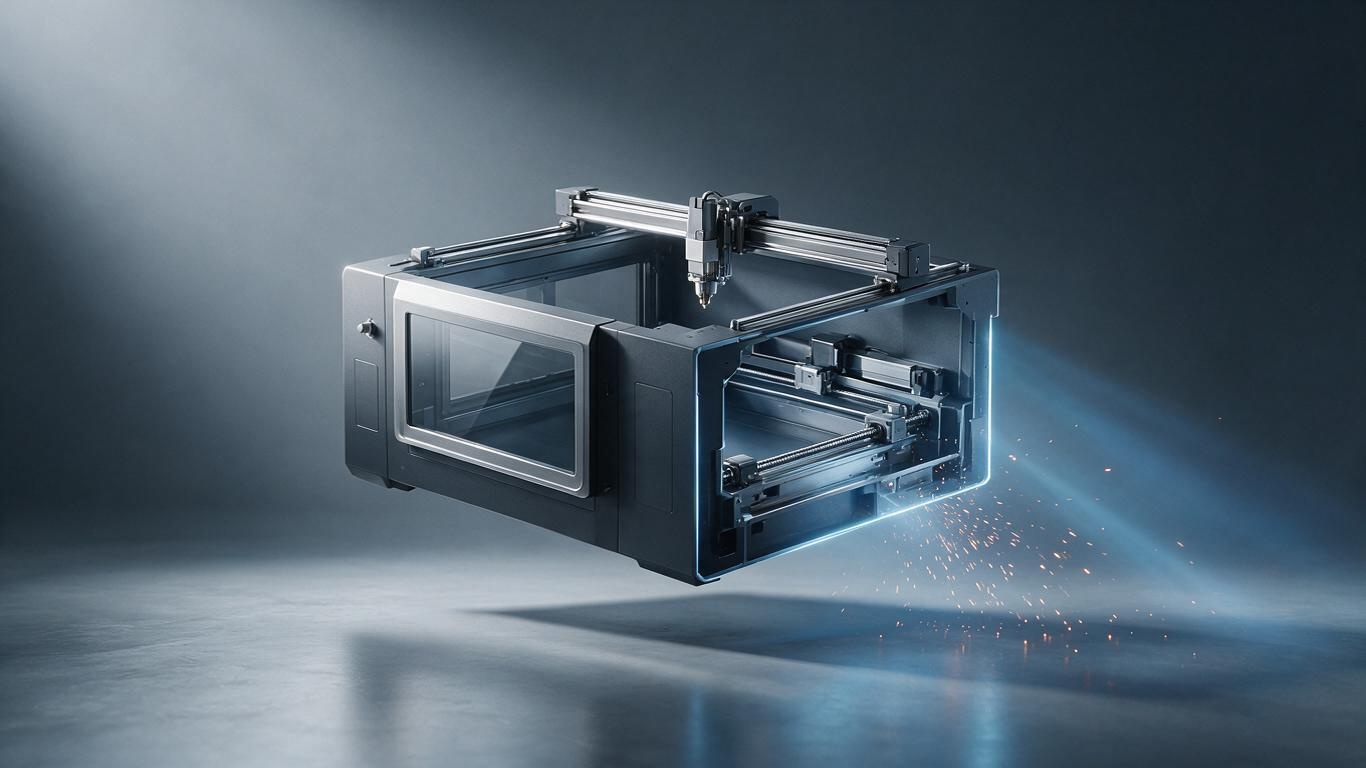
It's 1:30 a.m. in Chang'an, Dongguan. The lights are still on in a meeting room where a laser-cutting equipment manufacturer is staring at a booth floor plan. In 18 days the trade show opens — and their 6-metre flagship machine can't fit a standard booth, let alone run a live demo for three days straight.
Their first question wasn't “should we make a video”. It was “who is the best 3d animation production company in dongguan”. They had already spoken to four studios and come back with three quotes: the cheapest around USD 1,100, the highest at USD 3,700, and a middle one that said nothing beyond “3D modelling and rendering”.
A 3x price gap for what looked like identical deliverables — that is the reality of 3d animation production dongguan buyers run into every week. We took the project for one reason: the client never asked how fast we could deliver. They asked whether we could explain what happens inside the machine.
One film, three jobs
Most people assume an equipment animation is just “the machine spinning”. The real difficulty is the intended use. This client handed us three scenarios:
- Trade show big screen: no voice-over, almost no subtitles — the visuals had to tell a complete story in 90 seconds and stay watchable on loop all day;
- Website hero: cut to 15 seconds, with the cutting head pressing down and sparks flying inside the first 3 seconds — the exact moment purchasing decision-makers look for;
- Overseas dealer kit: English voice-over plus spec callouts, split into 5 short clips that resellers can repost on local social channels.
Three scenarios produced one master film, two edit versions and five clips. That is also the first source of quote differences: the cheapest vendor quoted a single 60-second film and nothing else.
18 days, from CAD to final render
The show date locked the schedule, so we compressed it like this. Days 1–2: the client supplied CAD drawings and on-site reference footage. Days 3–6: modelling and topology cleanup — we ran an AI-assisted 3D modeling workflow, letting the AI handle repeated structural parts from the drawings while artists refined only the visible high-gloss surfaces, which cut modelling time by roughly 40%. Days 7–10: internal cutaways and materials. Days 11–14: motion rhythm and lighting. Final four days: rendering, grading, voice-over and multi-version output.
The cutaway sequence was the centrepiece. Every selling point of a laser cutter lives inside the chassis — the gantry, the servo drives, the pallet changer. We opened the machine in three stages, holding two seconds on each cut so the viewer's eye could follow the opening edge. We validated the same rhythm in our earlier breakdown of how a precision CNC machine animation was built: industrial buyers don't mind slow, they mind confusing.
The hard part isn't modelling — it's the industrial feel
Physically correct metal in a studio lighting rig usually reads as a grey slab. Real laser cutters have brushed grain, assembly gaps and panel colour variation between batches. Those imperfections are the industrial feel. Our approach: keep physically based rendering as the base, then layer two non-physical rim lights and an environment reflection map so the metal keeps a stable highlight line as the body rotates.
The second trap is rhythm. In live-action footage, machine noise is a natural time anchor — viewers rely on sound to know it's running. 3D animation has no such anchor, so visual rhythm has to replace it: 14 frames for the cutting head to descend, 8 frames of spark trailing, a two-second hold on each cutaway. The film carries no narration at all, yet test viewers could name all three selling points accurately.
What happened after delivery
These figures came from the client: over three show days, the looped film generated 217 qualified leads, roughly 70% more than the same booth footprint a year earlier. After the 15-second hero video went live, average time on the machine page rose from 48 seconds to 2 minutes 14 seconds. The overseas cut was forwarded into dealer groups across six countries, and two of them replied with screenshots asking for pricing.
The more interesting part came later. The client kept the 3D assets. When they launched a new model the following month, only the mid-section and spec callouts changed — and a fresh short film was ready in three days. That is the difference between buying one film and buying a reusable asset library.
Back to the original question
There is no single answer to “which studio is the strongest”, but there are three checks you can run on the spot. First, ask for a breakdown in your own industry — not “we've done a lot of 3D”, but which specific structure was hardest and why. Second, check whether the quote lists shot count, number of cutaways, revision rounds and deliverable versions. Third, ask whether you're buying a film or an asset library (models, textures and layered project files included). We go deeper on those criteria in how brands should choose an AI 3D animation vendor.
If you also have a machine that won't fit a meeting room and can't be shot from the inside, contact us — look at the case first, then talk numbers.