The email arrived on a Thursday at 4 p.m. A brand director at a baby-products company needed a film for a stroller that was still in prototyping — no 3D files, no physical sample, and a channel conference the following Tuesday. Nine days, two rounds of revisions, one deadline that could not move.
It is a fairly typical product animation outsourcing case, and worth walking through end to end. The client sits in Ningbo, the factory is in Guangdong, and most of the supply chain is in the Pearl River Delta. They had talked to two local studios before choosing us — a team doing 3d animation production dongguan-based, close enough to walk the sample line and measure the frame ourselves.
Here is how those nine days were actually spent, and what we would tell any brand about to outsource a product film.
Start with the audience, not the model
The original brief said “premium and high-end.” That is not something you can execute. We opened with a forty-minute call and asked three questions only: where does this play, who is watching, and what should they do afterwards.
The answers separated fast. The channel conference screen faces distributors and retail buyers — they care about structural reliability and build quality. The vertical cut runs on Douyin and the Tmall detail page, facing first-time parents aged 25 to 35 — they care about one-hand folding and whether it fits in a trunk. Same stroller, two different stories. We delivered one 45-second master plus three 15-second vertical cuts, rather than one film resized three ways.
Why this stroller could not simply be filmed
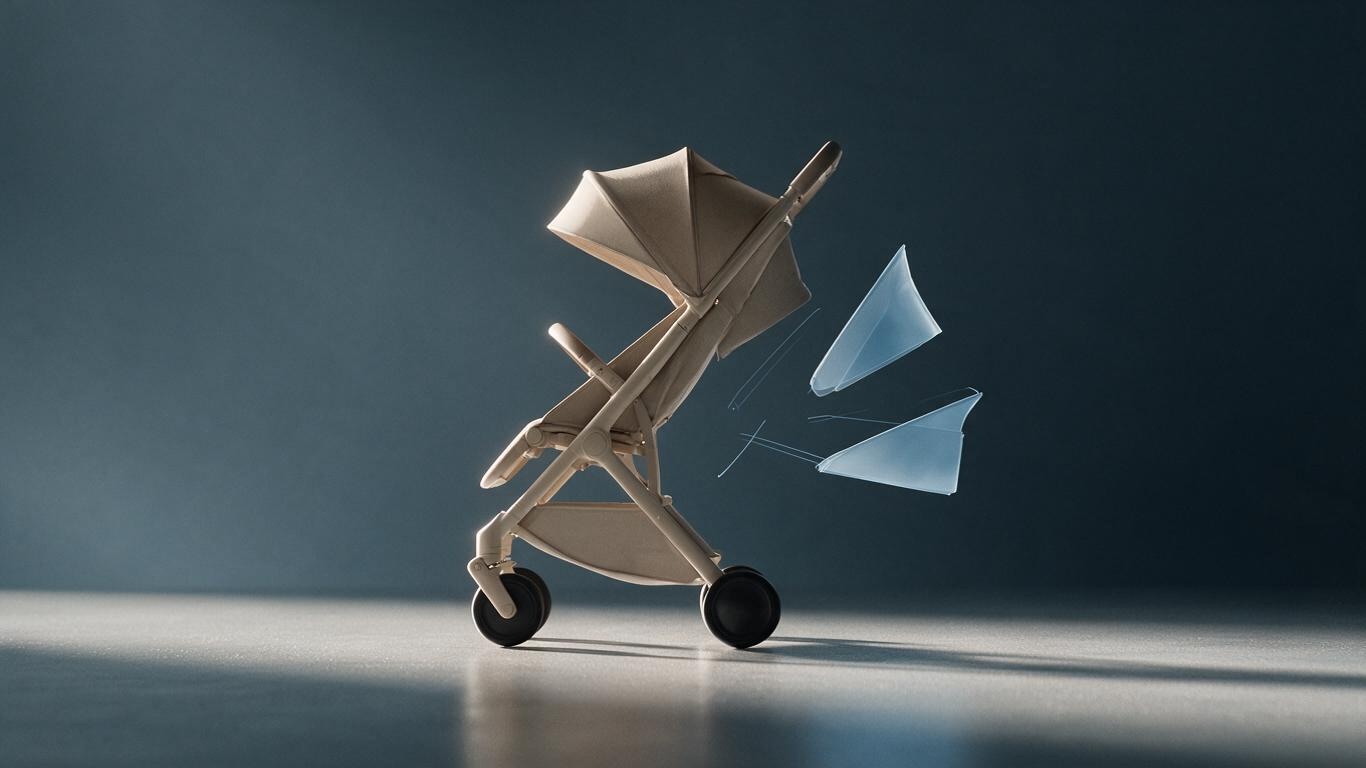
The instinct is always to rent a studio and shoot the real thing. It does not work here. Only one prototype existed, painted grey, while the launch shipped in four colors. The folding mechanism needed to show internal linkages, which no camera can see. And the client wanted a one-hand-fold scene with a child in the other arm — casting and scheduling that alone would have eaten the budget.
AI plus 3D handles all three: the frame can be cut open, made semi-transparent, slowed down; colors are a parameter change, so four versions render together; the usage scene is built from the product itself plus environment light, with no talent required. We covered the wider trade-offs in from live action to AI plus 3D, so we will not repeat them here.
The nine-day schedule
Nine days, including two revision rounds. Working backwards, every slot was tight:
- D1: brief locked, storyboard approved. Eight shots, one 45-second master, vertical cuts from the same source.
- D2 to D3: modeling and structure rebuild. Simplified CAD from the client plus factory photos filled in the folding joints.
- D4: material and lighting tests. Four colorways in one pass, client signed off the same day.
- D5 to D6: animation. The fold is the whole film, and its timing was reworked three times.
- D7: render, edit, sound. Vertical versions cut in parallel.
- D8: first revision. Six notes, all about shot length.
- D9: final polish, delivery in 16:9, 9:16 and 1:1.
What made this schedule work was not overtime. It was that the client put the decision-maker in the chat on day one. One person signed off, and nothing was relayed through three departments that each wanted five changes and none of which wanted to approve.
The hard part was the fold
The mechanism has seven linked joints. When it collapses, frame, canopy and seat move together, and if the order is off by a hair it reads as broken. Our first pass looked fine to us. The client's technical lead spotted it immediately: the canopy was folding faster than the frame, which the real product never does.
We pulled the factory folding video apart frame by frame, re-timed the sequence, and added a 0.3-second ease on the key joints. That gap between looks right and is right is the most underestimated cost in outsourcing. It is also why we insist on a physical unit or factory footage — animation built purely from render references does not survive an expert's eye.
One more note: we used AI-assisted motion generation for the repetitive looping actions and kept human hours for the critical seven or eight seconds. Roughly a thirty percent efficiency gain, which in practice means one extra revision round inside the same window.
What the numbers looked like after delivery
Two weeks after handover the client shared results: video completion rate on the detail page moved from 31 to 58 percent, add-to-cart rose around twenty percent, and the conference cut was requested by three distributors for in-store screens. One product is not a statistic, but for a cold launch the direction is right.
The more interesting part came later. A month after launch the client asked for two additional models. Because the scenes and lighting were built as modules, swapping colorways and model variants took two days for both. That is the real economics of 3D against live action: expensive once, cheap forever after.
Three things that make outsourcing work
First, write the purpose in the brief, not just the adjectives. “Premium” means nothing; “shown to distributors, needs to look solid” means everything. Second, hand over the asset list early — CAD, physical photos, feature priorities, delivery specs. Every missing item costs a day. Third, put the review milestones in the contract: how many rounds, who signs, what happens beyond that.
The same logic applies to picking a studio. Do not judge on the final film alone; ask for the process — modeling records in your category, storyboard files, revision trails. We laid out the evaluation criteria in how brands choose an AI plus 3D animation vendor, which pairs well with this case.
If you have a product launching and you are stuck at cannot film it or filmed it and cannot change it, send us the brief. Our 3d animation production dongguan team sits in the Pearl River Delta, so factory visits and sample reviews are easy — talk to us and you will usually get a schedule and a storyboard direction before any pricing conversation.