4:30 p.m. on a Friday
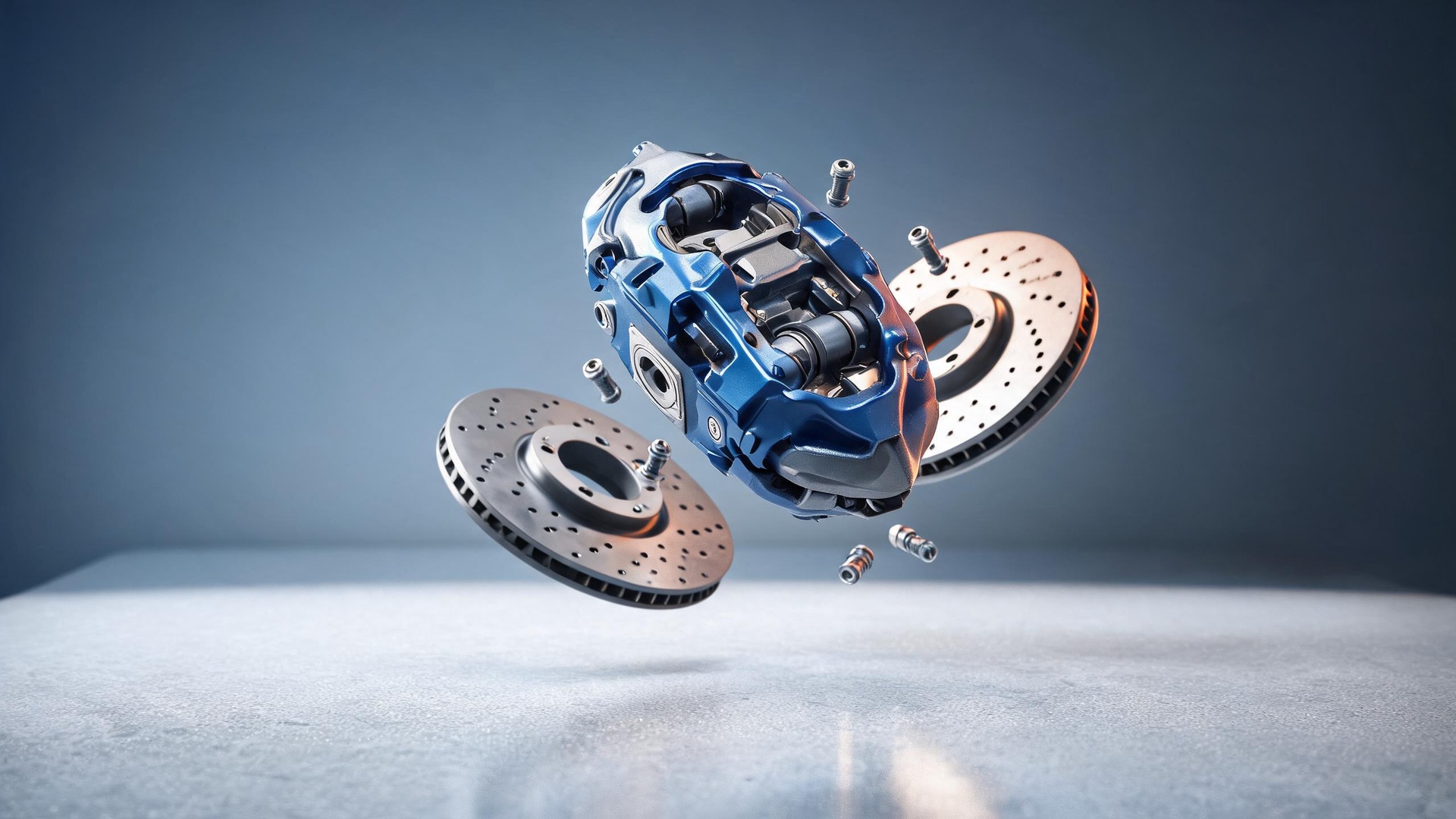
The owner of an auto-parts factory in Chang'an, Dongguan, sent over a phone clip: harsh workshop lighting, a modified brake caliper sitting on a fixture table, his hand turning it twice. The message read, ‘No matter how I shoot this thing, it looks cheap.’ They were heading to a trade show in Germany the following month, their site had just been rebuilt, and the product page still carried three blurry photos. Our answer was simple: use 3D animation production to take the caliper apart on camera — how the body takes load, how the pistons push, where the fluid goes. Let the shots explain it, no voiceover required.
The project became one of our favourite builds of the year. Working as a 3d animation production dongguan team has one obvious advantage: the factory is a ten-minute drive away. Drawings, a physical sample, and a quick call with the engineer on the floor beat any brief stuffed with adjectives.
The hard part was never the exterior. Anyone can scan a caliper shell. What an engineer-buyer wants is inside: opposed pistons, oil galleries, remaining pad wear. A camera can't reach any of that; a 3D scene can make it the hero. So we didn't open the software on day one. We put the client's engineer on a call for forty minutes and asked him to explain, in plain words, why this part costs what it costs.
Four stages, and the first cut was approved
The schedule was ten days. Tight, but once the pipeline is clean it isn't scary. First we turned the client's STEP files and assembly drawings into a usable hierarchy and simplified every part that adds nothing to the story — circlips, the inside of the dust boot, non-load-bearing bolts. The polygons we saved there decided whether the rest would run at all. Stage two is the soul of the film: the cutaway design. Instead of the usual slice-in-half, the housing opens outward like petals, revealing pistons and galleries, and that motion is itself the line of dialogue: look, here is the complexity.
Stage three is motion and fluid. On a real car the clamping action lasts a fraction of a second; in the film we stretch it to four seconds so the layers read: hydraulic pressure pushing the piston, the piston pressing the pad, the pad meeting the disc. Fluid in the galleries is a translucent blue band whose speed follows pressure — not a decorative line drawn afterwards. Stage four is lighting and delivery: cool white key on the metal edges, warm amber rim for texture, deep grey-blue gradient behind, product standing centre frame.
There was one small detour. When the client watched the first cut he went quiet for three seconds, then asked, ‘Can you remove the house number?’ We had reproduced a raised detail from the drawing that he read as advertising. Removing it made the frame cleaner. That note went straight into our internal rules: in industrial 3D animation production, the structure is the message, and anything extra is noise.
Where the film actually ended up
The final cut runs 38 seconds, delivered in landscape and vertical. Landscape plays on a looping trade-show screen with ambient music and no voiceover — walk-by visitors understand the structure without reading a word. Vertical is cut to 15 and 8 seconds for the site's hero section and the Alibaba product page, opening on the cutaway. The client reported two numbers: far more visitors staying past 30 seconds at the booth than at the previous show, and more than double the enquiries on that product page within two months. Modest numbers, but for a category with four-figure USD price tags, enough.
What surprised us more was the second life of the asset. The client pulled stills from the cutaway for an installation guide and cut the fluid sequence out for dealer training. One film quietly became a small library. That's the most underrated property of 3D animation production: what you ship is not only a video but a reusable 3D structure. We saw the same pattern on a machinery product demonstration animation — the less you can see inside a product, the more this approach earns its keep.
Three things we would say earlier next time
First, don't treat the drawing as the only truth. What the line actually assembles is often two revisions ahead; the physical sample is the judge. Second, don't chase spectacle. Buyers in auto parts are pragmatic — clarity, credibility, detail. One piston in the wrong place and the whole film is worthless. Third, don't wait until delivery to think about channels. Aspect ratios, the three-second hook, whether stills must work standalone — decide these at script stage and you save ten times the cost in fixes. We collected the finer versions of these traps in five pitfalls brands hit when producing product animation.
Vendor selection has its own method, by the way. Watch the questions they ask, not the reels they send. A team that opens with ‘how many versions, where will it run, who is watching’ tends to be more reliable than one that opens with a running time and a price. We wrote the criteria in four dimensions brands use to pick an AI+3D animation vendor, and yes, we hold ourselves to them.
If you're sitting on a product that refuses to look premium on camera — caliper, pump housing, valve, connector, module — send it over. Contact us, ten minutes on a call, and we can probably tell you what it could become.