
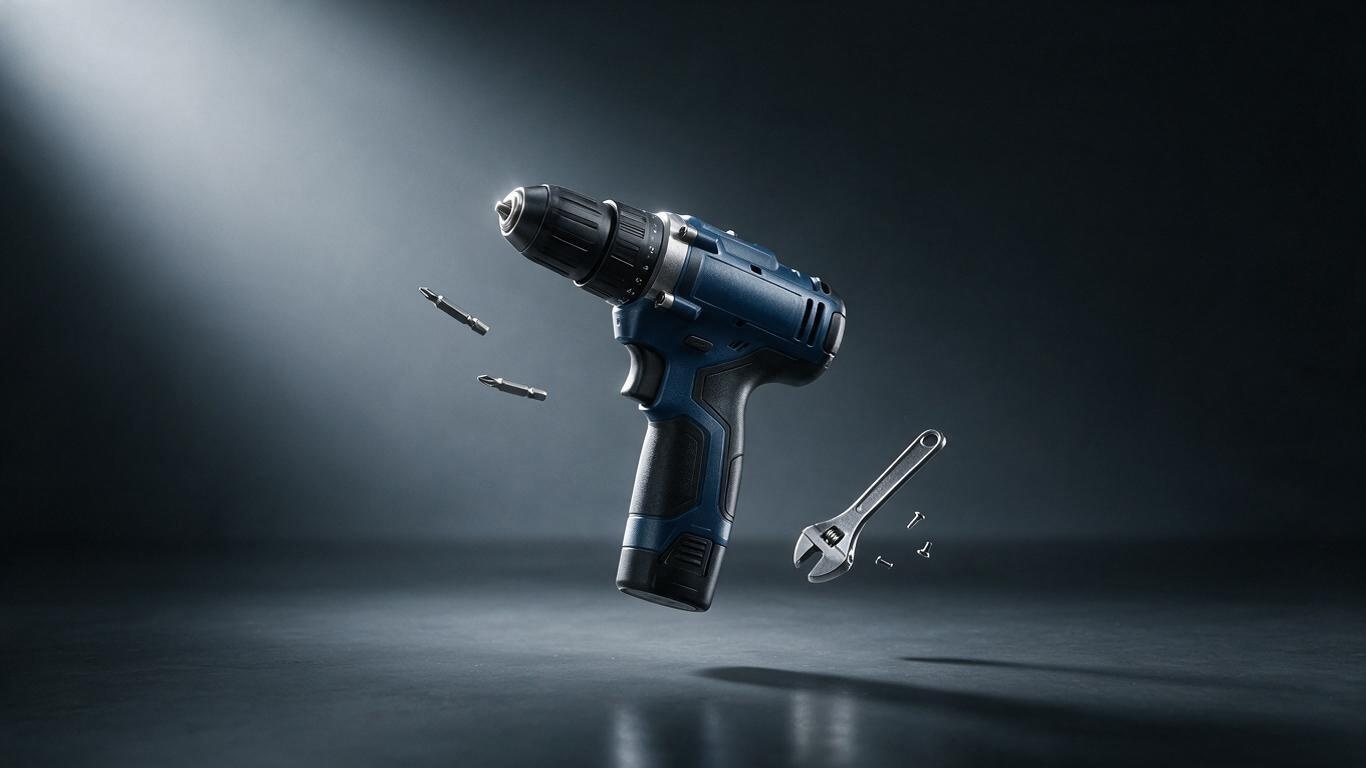
On the first afternoon of Canton Fair, a German buyer stood in front of a tablet at a Ningbo power tool exporter's booth for a full ninety seconds. He didn't reach for the catalogue. He didn't ask about price. He pointed at the cordless drill rotating slowly on screen and asked: can this run on 220V? Three months earlier, the same booth had nothing but white-background studio photos, and the average visitor stopped for under eight seconds.
What changed was a 90-second product demo built with ai 3d animation production. No actors, no factory footage, no voiceover — just camera work and structure. It put an eleven-year-old OEM tool brand on the shortlist of a European distributor for the first time.
This article is a teardown of that single project: how the brief was written, how the internals were cut open, why the shots are ordered the way they are, and what the numbers looked like afterward. If you make power tools, hardware, or industrial parts, it should save you a couple of rounds of trial and error.
1. Why a static image can't explain a drill
The client's original complaint was simple: our product photos are decent, people just don't get it. The problem was never image quality. Torque, runtime, chuck geometry, airflow paths and overload protection all happen inside the housing. No still photo, however sharp, can show that. What a buyer actually wants to confirm is whether the tool holds up on site — and a photo cannot answer that.
So the first rule of the project was: stop shooting the shell, explain the structure. The film is built around three movements — chuck engagement, gearbox transmission, battery pack insertion. Each one maps to a real question inside a purchasing decision.
2. Three models, 18 days, one hero film plus three cutdowns
The client is a lithium tool manufacturer in Yongkang, Zhejiang, with around thirty staff and an export-only business. Rather than the full catalogue, we built three flagship models: a cordless drill, an angle grinder and a cordless impact wrench. The deliverables were one 90-second hero film and three 15-second vertical cutdowns.
We started from the client's CAD files plus two physical samples, rebuilt the geometry parametrically, then prepared the internal sections. Gearbox, brushless rotor and cooling channels — parts nobody normally sees — were layered so the camera could pass through them slowly, like a miniature endoscope entering the housing. Structural demonstration works the same way in heavy equipment, which we covered in our industrial machinery animation case study.
The real time saver was the AI layer. Repetitive modelling, initial surface generation and batch denoising used to eat half the schedule; pushing them earlier let the team spend its hours on motion logic and pacing. Final delivery: 18 days, less than half the two months the client had budgeted.
3. Three counter-intuitive decisions
First: cut half the products. The client wanted a dozen SKUs on screen; we kept three. A B2B demo exists so a buyer remembers one product, not to memorise a catalogue.
Second: no people, no locations. Many tool makers insist on factory footage and workers on site for authenticity. European distributors want comparable specs and visible structure, not mood. The whole film uses a dark grey studio backdrop and clean rim light, keeping every bit of attention on the product. We wrote the underlying criteria in how brands choose an AI 3D animation vendor — use it as a checklist when you evaluate suppliers.
Third: add one cutaway shot. It is the only visual flourish in the film — the housing splits open and the gears mesh in slow motion. Internally the client worried it looked too technical. That shot is exactly what made the German buyer ask his first question. Purchase decisions are not won by beauty; they are won by the moment someone confirms the thing will work.
4. Results: more than one nice number
Six weeks after launch: average dwell time on the product page went from 42 seconds to 2 minutes 18 seconds; reply rate on outreach emails with the video embedded climbed from 3.1% to 7.4%; QR scans at Canton Fair tripled versus the previous edition. The most telling feedback came from a Dutch distributor, who told us their internal review team now uses the animation as the product manual.
One easily overlooked point: the animation is not a one-off asset. The hero film runs on the homepage, the 15-second cutdowns go to social and email, and the cutaway shot gets exported as a still for the technical spec page. One production, four channels — which is why we now render multiple aspect ratios in the same pass instead of cropping later.
5. One honest note for tool makers
The live-action versus 3D question is not about which looks more premium. It is about which one answers the question. If your selling points are specs, structure and durability, live action will always come up short. If they are feel, scent or how something wears, live action still wins. We break that line down further in from live action to AI 3D: a workflow comparison.
Back to that booth. The German buyer did not place an order on the spot. But three months later his technical team sent an email with screenshots from the film, annotated with seven parameters they needed confirmed. That is the most honest value of ai 3d animation production in a B2B setting: it isn't built to make people impulsive, it's built to make people ask questions.
If you have a hardware product that photos fail to explain, contact us with drawings or a sample, and we can send you a structural demo plan within 48 hours.