Picture this: a glass half full of water sits at the edge of a table. A fingertip nudges it. It tips, falls, hits the floor, shatters, and the water sprays outward. The whole thing takes under two seconds. The viewer has exactly one reaction — "that's real." But if any single link in that chain is off — water that looks like plastic pellets, glass shards drifting too slowly, a puddle that refuses to spread — trust collapses in a fraction of a second.
That's the most overlooked and least forgivable part of AI 3D animation production: physics. Over the past two years, AI has pushed down the barrier to modeling, texturing, lighting and basic motion, and a small team can now produce footage that "looks expensive" in a week. But looking expensive and looking real are two different things. AI is good at generating things that resemble reality; it is bad at conserving it — mass, momentum, friction. And viewers of product films, especially industrial clients, are brutally sensitive to those laws. They handle the real product every day. Tell them a machine weighs 80 kilos and then let it fall like 80 grams, and you've lost them. We learned this the hard way on a precision machinery animation project; the client's first-round feedback was a single line: "the landing is too light."
Working in 3d animation production dongguan brings a built-in advantage and a built-in pressure: most clients here come from manufacturing. Hardware, furniture, molds, appliances, new-energy components — their products come with exact weights, dimensions and structural relationships. The moment an animation drifts away from physics, the client kills it with one sentence: "the cabinet door doesn't open at that angle" or "that latch wouldn't snap like that." So in our pipeline, physics parameters are not art parameters. They sit next to the engineering drawings.
Rigid bodies: viewers are quietly running gravity math
Rigid body is the bottom layer and the most underrated one. When a product rolls, slides, flips or collides on screen, the viewer doesn't reach for a calculator, but their eyes are checking three things automatically: weight, contact, decay.
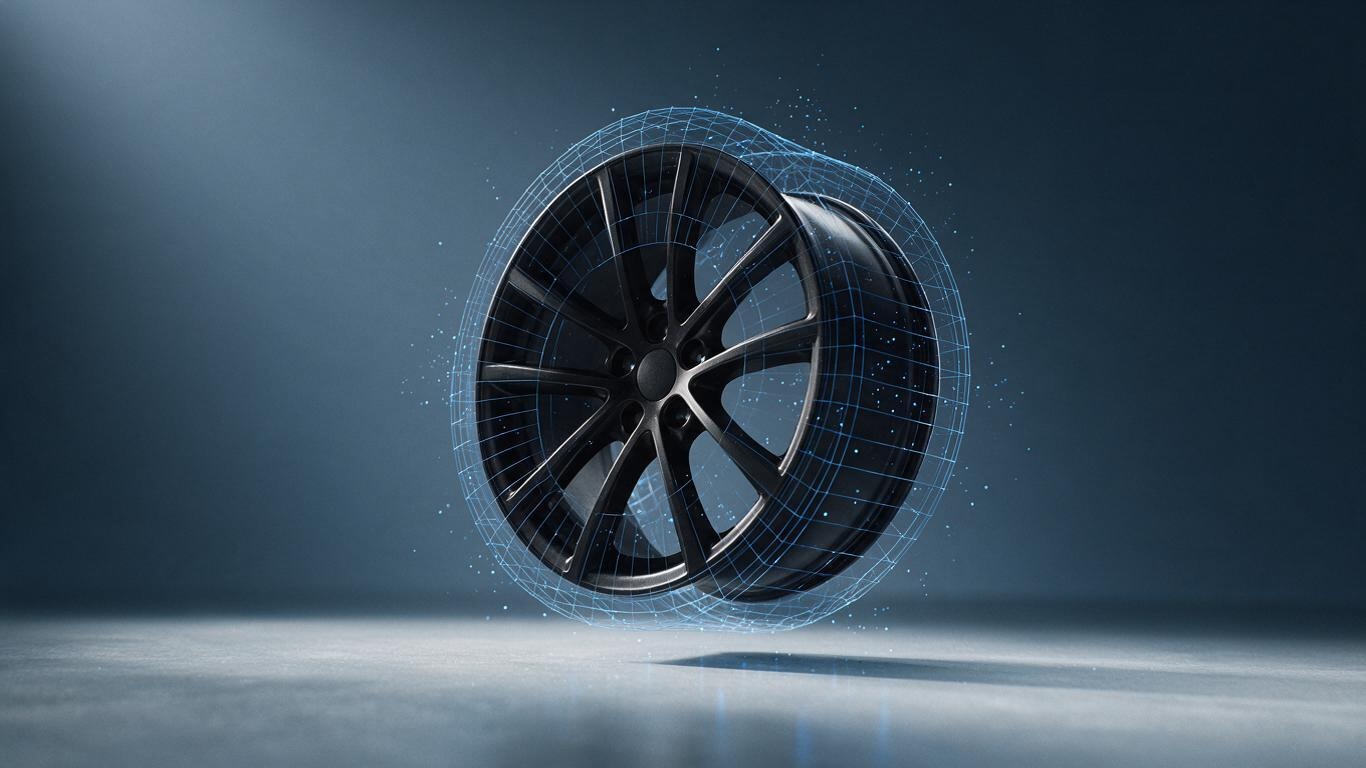
Weight comes from mass and center of mass. Take the same 30cm metal box: put the center of mass high and it pitches forward when it lands; put it low and it barely bounces. Plenty of animations look "floaty" not because the keyframes are sparse but because the center of mass was left at the geometric center. Contact comes from friction coefficients and contact stiffness. Metal on tile gives a sharp, short double bounce; metal on a rubber mat barely bounces at all, and viewers clock the difference instantly. Decay is damping — nothing in the real world slides at a constant speed forever.
Our habit is simple: ask the client for two numbers up front, a weight range and a shell material. Even "around three kilos, aluminum alloy" beats no question at all. With those two inputs, the first rigid-body pass usually lands at about seventy percent right, and the rest is art direction rather than guesswork — far cheaper than hand-keying everything from zero.
Soft bodies and cloth: where home and furniture products give themselves away
If rigid bodies are the skeleton, soft bodies are the face. A sofa cushion rebounding after compression, bedding settling into a natural drape, a curtain lifted by a draft and falling back, a leather bag dimpling under a finger — all soft body. It's also the hardest category, because humans interact with fabric and foam every day and judge wrongness almost instinctively.
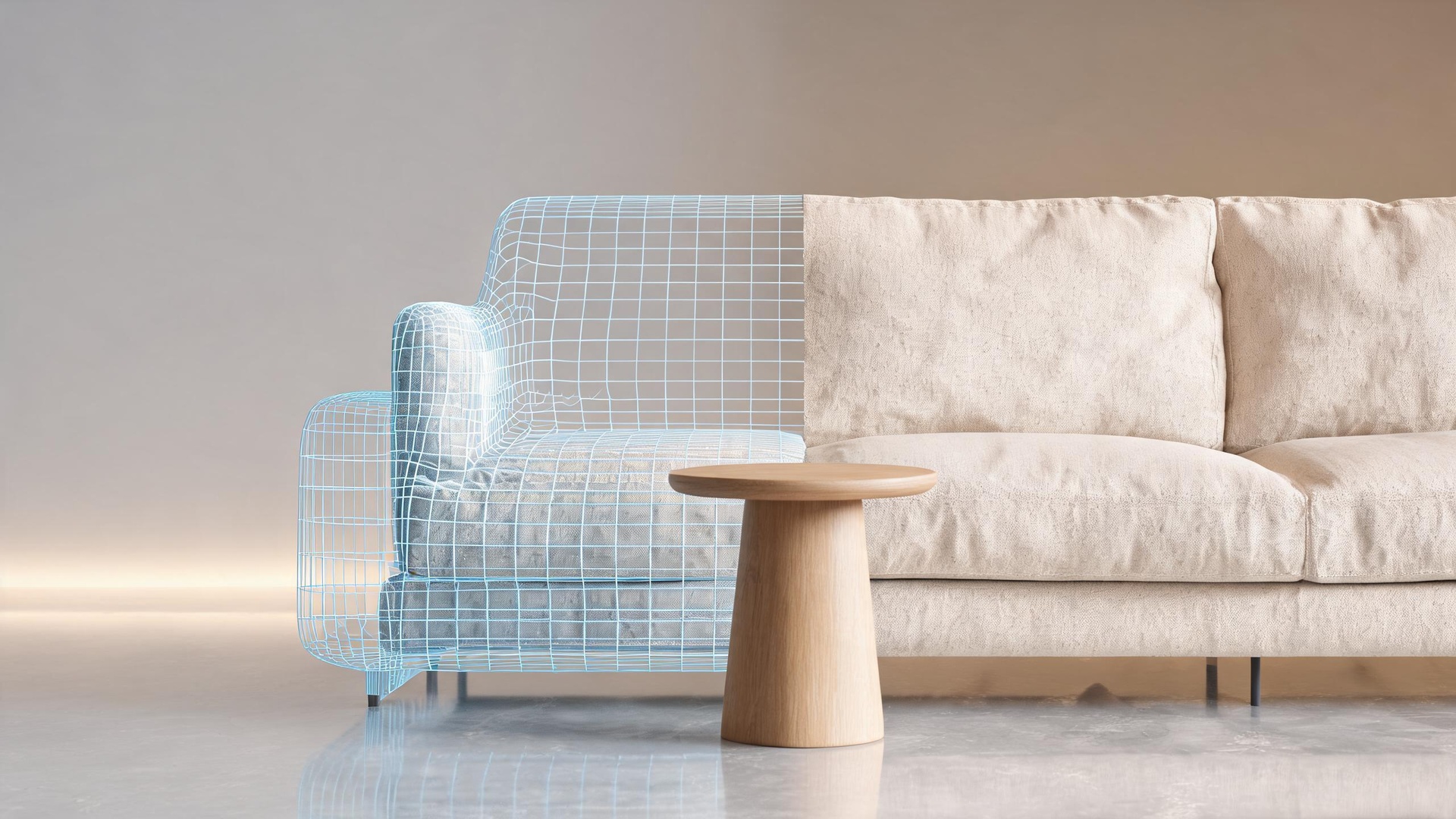
On home and furniture projects we usually split soft body into three layers. The outer fabric needs directional stretch — taut along the warp, with give along the weft — otherwise creases form like a rubber sheet and look averaged out. The filling layer needs a compression curve; a cushion does not sink linearly, it gives easily for the first few centimeters and then firms up, and that non-linearity is where realism comes from. The frame sets the boundaries of deformation; wood and metal frames rebound completely differently. AI helps here by reverse-engineering approximate deformation ranges and rebound rhythm from a reference clip, cutting the most tedious parameter-hunting stage by more than half. A human still signs off on the result.
One detail people miss: residual deformation. A cushion that has been sat on doesn't return to a hundred percent. It keeps a slight, uneven looseness. Add that imperfection and the shot comes alive.
Fluids and grains: the part AI still needs a human on
Pouring liquids, sauce clinging to a wall, powder streaming out, paste being extruded — these appear constantly in e-commerce product animation and are exactly where AI generation fails most often. The reason is structural: fluids have no fixed shape, so AI lacks hard constraints and happily produces water that sprays upward or foam immune to gravity.
Our approach is layered. First, simulate the big shapes — flow rate, splash direction, spread radius on impact — and let that layer obey gravity and surface tension strictly. Then use AI to assist with high-frequency detail like foam, mist and micro-droplets, because there are thousands of them, each is tiny, and nobody inspects them individually. Finally, a human fixes the contact surfaces, the ring where liquid meets glass or product. If that ring is muddy, the whole shot collapses. Same logic for powders: the angle of repose varies a lot between materials, and a default value makes everything look like sand.
So what does AI actually do?
People ask me whether the AI in AI 3D animation production is just marketing, given that physics still comes from simulation. It isn't — it's just positioned differently than most assume. AI doesn't calculate physics; it handles three earlier, more time-consuming jobs.
First, asset prep. Initial models of shells, structural parts and packaging can now be generated at usable quality in hours via an AI 3D modeling workflow, so collision bodies for simulation can start rough and refine later instead of waiting for the final mesh. Second, parameter estimation — pulling plausible friction, rebound and flow ranges from a reference clip beats trial and error. Third, plausibility checking: we sample frames and ask a model for physics-common-sense judgments. It's not accurate, but it narrows the search. Compared with the traditional live-action versus AI 3D pipeline, a physically credible product film now takes roughly a third of the time it used to.
Three low-tech ways to check whether the physics holds up
- Watch it muted. Kill the music and sound design. Music is the strongest cheating device in the business and hides most physics problems.
- Hunt the contact points. Frame-by-frame, look at where objects meet the floor, a hand or each other. Intersections, floating, or instant displacement means the simulation lacks precision.
- Ask an outsider. Show it to someone who knows nothing about the product and ask how heavy they think it is. If their estimate is off by more than double, the problem isn't art — it's the physics parameters.
Physics simulation is really about moving "good looking" up one notch to "believable." It isn't cheap and it isn't flashy, but it's the line between an ad and evidence. If you have a product film that just feels wrong and you can't say why, contact us — usually one look at the contact points tells us which layer is broken.