
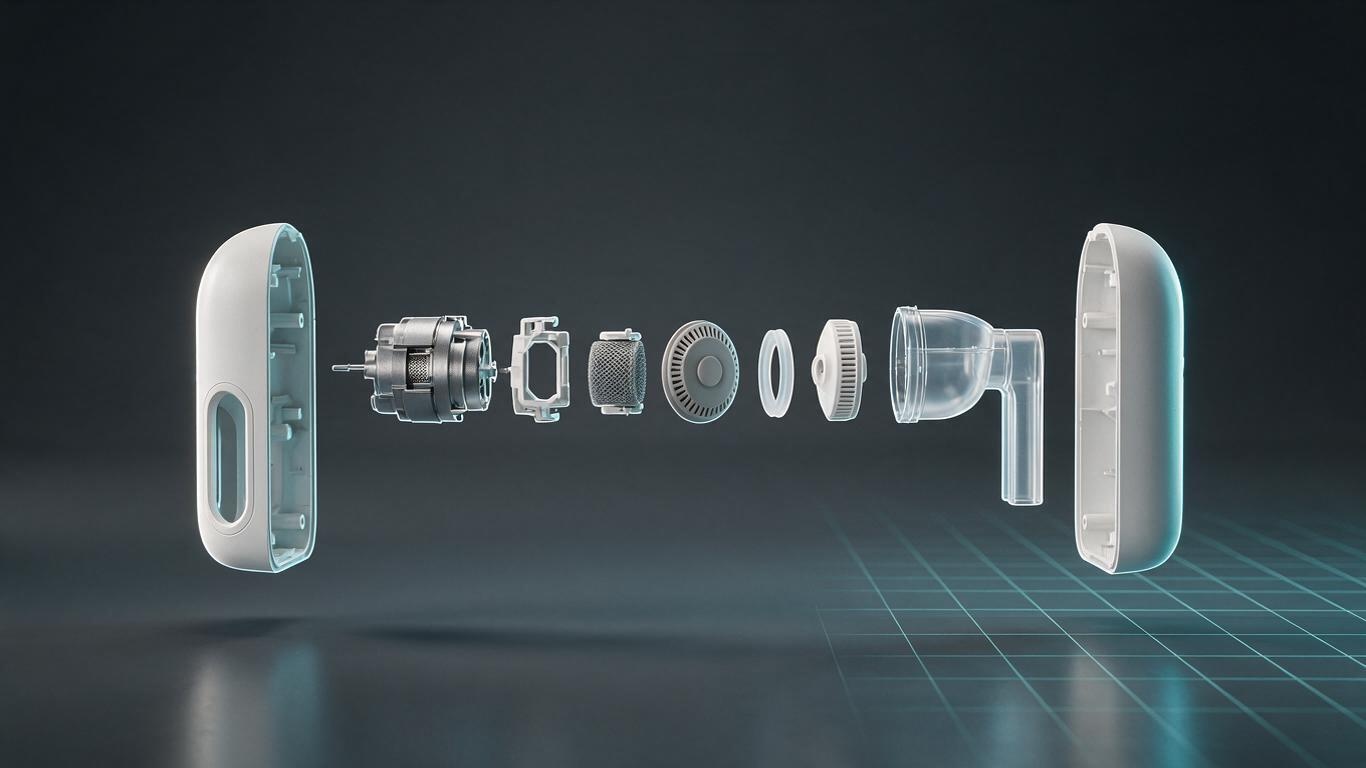
You have seen the shot a hundred times: a device hangs in mid-air, its housing slides apart, and the parts inside drift outward in slow motion before snapping back together. You finish the video thinking, so that is how it works. In the trade we call it an exploded view — and in ai 3d animation production, it is both the most demanding and the most rewarding kind of shot you can build.
A few years ago this was the exclusive property of industrial design studios and flagship launch events: expensive, slow, and painful to revise. Today, ai 3d animation production has pulled that barrier down — structure data processing, part rigging and motion curve generation have largely shifted from hand-sculpting to parameter tuning. Roughly a third of the films we shipped this year contained exploded sequences, for clients ranging from medical devices and hand tools to small appliances and auto parts.
Lower barriers, though, do not mean lower difficulty. The hard part of 3d animation production was never separating the parts. It is making every part separate for a reason, in the right order, at the right tempo. Here is what we learned the hard way.
Translate the structure data before you animate it
Clients send a STEP file, or sometimes just a handful of product photos — that is the reality. Engineering drawings speak the language of tolerances and assembly sequence; animation speaks the language of where the viewer's eye should be at second twelve. Between those two languages sits a translation step. We use AI to handle mesh decimation, internal cavity reconstruction and instancing of repeated parts, compressing hundreds of thousands of faces into a workable range; then an artist decides which parts must survive and which can be merged into a simplified structure. A complex handheld device might arrive with 400,000 faces and enter animation at under 80,000. Nobody notices, and half the production schedule disappears. If you build machinery, our AI 3D animation production case for industrial equipment walks through the same cutting logic.
Parts are not fireworks
The classic beginner mistake is turning an exploded view into an explosion — every component flying off in a different direction. It looks busy and communicates nothing. A real exploded view runs the assembly sequence backwards: housing first, then fasteners, then functional modules, then the core components. Each part must travel along the same axis it was assembled on. Linear stays linear, rotating stays rotating. And leave a breath of space between parts — even two or three pixels is enough for the eye to read two objects instead of one smear of colour.
Uniform speed is the enemy
Making the whole sequence glide at one even tempo is the fastest way to lose an audience. The eye needs something to catch up with. Let the parts settle for half a second so the structure registers; give a key component a short acceleration and a hard stop; make the reassembly slightly faster than the teardown so it feels like a satisfying click. Our rule of thumb for a 45-second sequence: at least three clear pauses and two accelerations. That is where viewers remember things. It is also the part AI cannot do for you — it generates curves, but knowing where to stop is still a human call.
Things that look cool and quietly cost you
Rendering a hundred parts individually means nobody remembers any of them. Labelling every component with a callout turns the film into a moving manual. Finishing without reassembly leaves the emotion hanging in mid-air. And the most subtle one: no scale reference, so the viewer never learns whether the product is pocket-sized or the size of a fridge. All of these are easy fixes at the storyboard stage — provided someone flags them there. If you are still weighing live action against CGI, the live-action vs AI+3D workflow comparison goes deeper.
What AI actually does in an exploded view
Three concrete things. Variants: five models, three colourways, eight languages used to mean 120 rebuilds — now the structure stays and the parameters change. Revisions: when a client asks on day seven to move a clip, we edit a motion instruction instead of reopening the model. Consistency: AI-generated motion curves are naturally smoother, removing the jitter that creeps into hand-keyed timelines. But AI owns efficiency, not judgement. Which parts deserve screen time, which angle explains the mechanism, where the pause belongs — that is still on us.
There is a simple test for an exploded view: after watching, can the viewer explain how the product works in their own words? If yes, the film earned its budget. If you have a product whose insides deserve to be seen, contact us and send the drawings over — we will tell you which three parts are worth pulling out first.