
What You Are Really Buying Is Fewer Revisions
If you are searching for how to choose a 3D product animation company, you have already moved past the question of whether you need product animation at all. You are now in the harder phase: comparing quotes that differ by 300%, portfolios that all look polished, and delivery promises that all sound reasonable.
Here is the uncomfortable truth we have learned after producing hundreds of product animations: the line item that decides your final cost is not modelling, and it is not rendering. It is revisions. A studio that understands your product before the first frame is rendered will cost you two rounds of changes. A studio that does not will cost you six.
So instead of a ranking, here is the seven-point framework we would want a brand to use when evaluating us — and our competitors.
1. Look for the right category, not the flashiest reel
Every studio puts its most spectacular work at the top of the portfolio. That tells you very little. What matters is whether they have shipped something close to your product.
Material logic differs enormously by category. Food animation lives or dies on liquid flow, crumb structure and perceived freshness. Industrial equipment requires accurate motion constraints and internal cutaways. Beauty and skincare demand restraint with specular highlights and translucent glass. A studio that only renders home appliances will almost certainly make your serum bottle look like injection-moulded plastic in v1.
Ask for a full, uncut piece in your category released within the last six months — not a montage. Then ask: “Which shot was the hardest, and how did you solve it?” Studios that actually did the work answer with specifics. Studios that did not answer with process.
2. Understand the production path before you compare prices
Live-action plus VFX and AI-assisted 3D are two different businesses. Neither is universally better, but the dividing lines are clear:
- Product still in prototype — only 3D works. There is nothing to film.
- Packaging or colourways change often — in 3D you edit a file; in live action you reshoot.
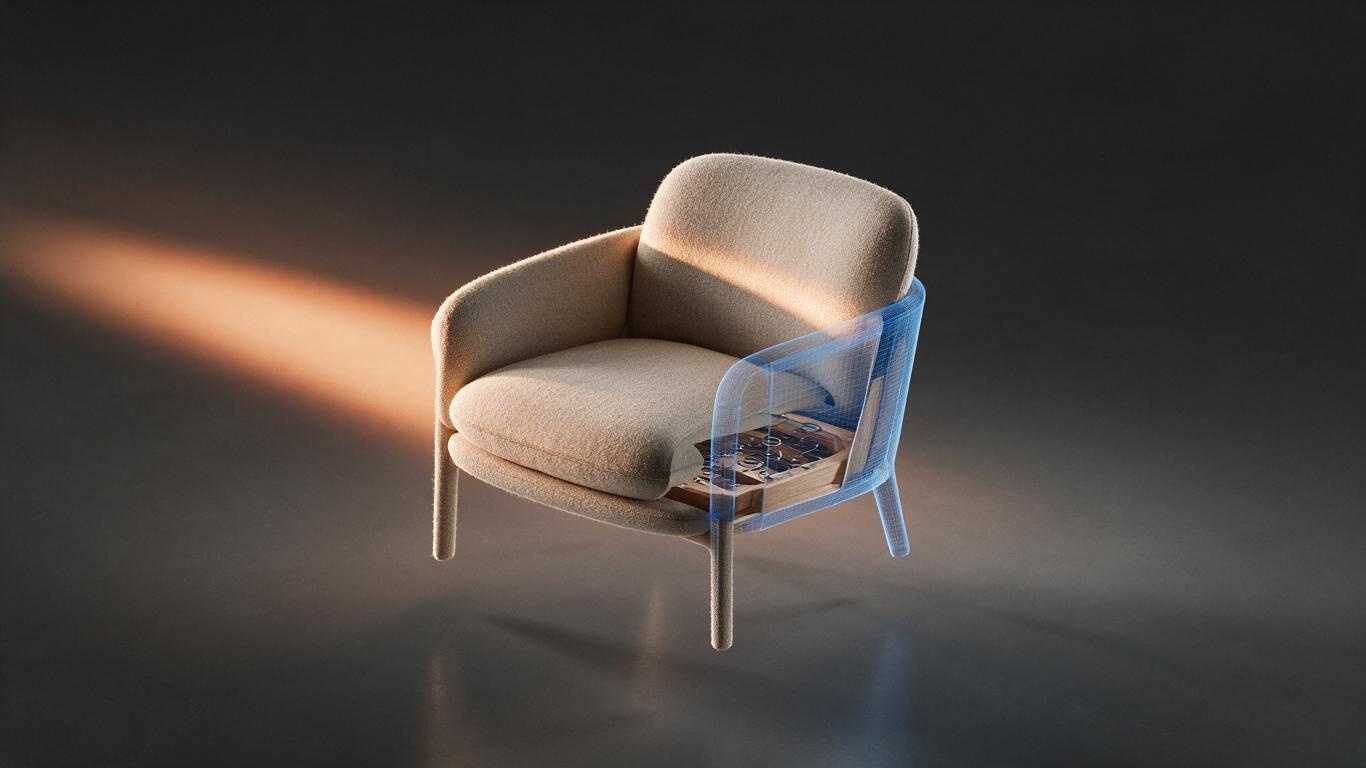
- Internal structure or working principle — 3D can cut away, explode and slow down. Live action cannot, or not affordably.
- Human emotion and lifestyle context — live action still wins.
The more parametric and standardised your product, the better 3D economics become. We broke this down shot by shot in From live action to AI+3D: comparing production workflows. Decide which camp you are in first; it removes most downstream friction.
3. Check whether the deliverables include reusable assets
Two studios quote the same 30-second film. Studio A delivers an MP4. Studio B delivers an MP4 plus the textured 3D model files. Two years later your packaging changes. Studio A charges you a full rebuild. Studio B changes a texture map.
Put these three questions in writing before signing:
- Do we receive the source 3D models (.fbx, .gltf, .blend)?
- Do we receive reusable material libraries and lighting presets?
- For new angles or new shots using the same model, is pricing incremental or full-rate?
First-time buyers skip this clause and discover they are locked in on their second project. It is rarely a small amount.
4. Study the pricing structure, not the total
A healthy quote breaks down into modelling, materials, animation, rendering, audio and compositing. A single lump sum with no breakdown gives you no leverage when scope changes — and scope always changes.
| Deliverable | Typical range (USD) | Typical lead time | Best used for |
|---|---|---|---|
| Single-product turntable (under 15s) | $450 – $1,200 | 3 – 5 business days | Marketplace hero video, PDP first screen |
| Feature demonstration (30 – 45s) | $1,200 – $3,500 | 7 – 12 business days | Launch, crowdfunding, A+ content |
| Brand-grade cinematic (60s+) | $3,500 – $12,000+ | 15 – 30 business days | Keynote, paid media, trade show screens |
When a quote lands well below the band, do not celebrate — ask how many revision rounds are included and what happens after. That single question surfaces most hidden costs. We catalogued the classic disputes in 5 pitfalls most brands hit with product animation.
5. Turn the timeline into dated milestones
“About two weeks” is not a commitment. “Script locked 24 Sept, first cut 28 Sept, final delivery 3 Oct” is. Ask for four checkpoints: script approval, model completion, first animated cut, final master.
Counter-intuitively, the studio that promises seven-day delivery on everything is the one to worry about. Complexity varies wildly between projects. A team willing to say “it depends on the cutaways” is more trustworthy than one that says yes to everything.
6. Find out who actually does the work
Ask, politely, about team composition: how many modellers, how many animators, local render farm or cloud, and whether anyone owns look development specifically.
The ceiling on your film is usually not the software — it is whether a human being is responsible for light. In lighting techniques in product animation we showed how the same CAD data reads as premium or as cheap purely based on a three-point setup. If nobody owns that, the output defaults to a template.
7. Price the communication cost, especially across borders
Time zones and language convert directly into money. Check three things: is there a single fixed point of contact, can they run weekly reviews in your working language, and are revisions confirmed in writing rather than verbally.
Our own data point: clients with clean communication loops average roughly 1.5 fewer revision rounds — three to five working days saved per project. We covered this in the four dimensions brands use to pick an AI+3D animation vendor.
A 30-minute scorecard that eliminates half your shortlist
- □ Full, recent, same-category work — not a montage
- □ Clear production path with reasoning, not just a price
- □ Reusable 3D assets included in deliverables
- □ Module-level pricing with revision rounds stated
- □ Four dated milestones instead of one vague promise
- □ Transparent team composition and render approach
- □ Fixed contact person and written revision sign-off
Any studio scoring five or more is worth a paid pilot. Resist the annual framework on the first date — spend a few hundred dollars on a 15-second turntable instead. One small film tells you more about comprehension speed and craft than a hundred slides ever will.
So how do you choose a 3D product animation company? Not the biggest, not the cheapest — the one willing to sit down and do the maths on your product data, your launch date and your reuse plan. People who are willing to count the small numbers usually care about the small details in the render too.