
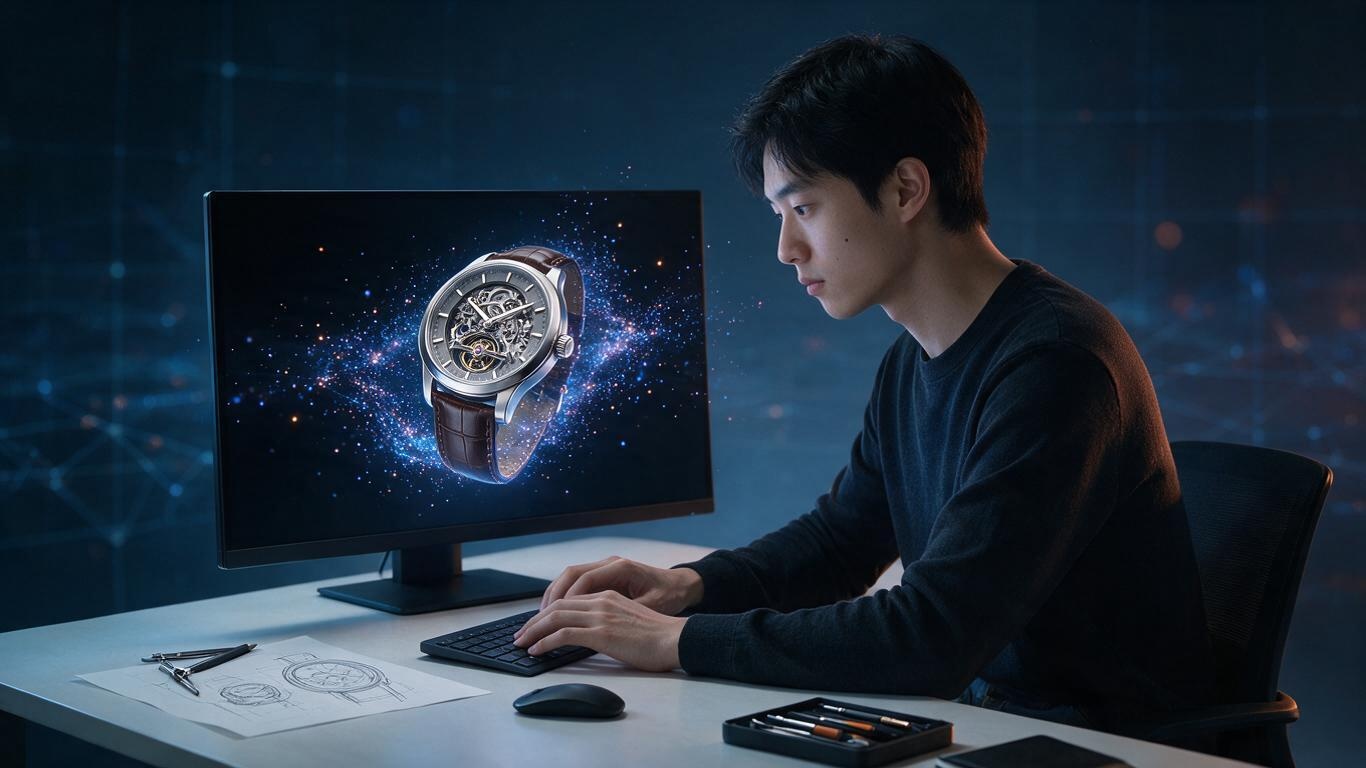
Have you ever had that moment while scrolling through short videos when you see an ad for a thermos — the bottle slowly rotating, water droplets tracing down the surface, so detailed that you almost want to buy it on the spot? Then you ask yourself: is this real or made digitally?
The answer: it's very likely an AI+3D product animation. In recent years, more and more brands have adopted this technique to showcase products that are not yet in production, highlight intricate internal structures, or even present entirely virtual concepts. Let's break it down.
Defined simply, AI+3D product animation starts by building a digital 3D model of your product, then giving it materials, lighting, and motion, and finally rendering the whole thing into smooth video frames. Along the way, AI isn't a "magic generator" — it's an accelerator. It helps auto-generate PBR textures, denoise renders, and even drive character motions, compressing weeks of work into days.
So why not just use live-action? Real footage has its own texture, but it has limits — you can't film a product that hasn't been molded yet, you can't show its internal mechanism, and every reshoot costs a fortune. AI+3D removes those constraints. Once the model is built, you can choose any angle, create transparent exploded views, or float the product in space. If you want to dig deeper into the live-action vs AI+3D trade-off, check out our previous article: From Live Action to AI+3D: The Evolution of Product Animation Workflows.
How is an AI+3D product animation actually made? It usually goes through five steps: modeling, texturing, rigging/animation, lighting & rendering, and compositing. AI helps at every step — auto light staging, denoising, even generating secondary motions. For a team like ours, AI isn't a buzzword; it's real leverage.
The use cases are rich: e-commerce hero videos that let shoppers "hold" the product on the detail page, crowdfunding videos that make pledges soar, and conference screens that make the crowd go quiet. From consumer electronics and food & beverage to machinery and furniture, AI+3D has a place.
In terms of budget, AI+3D product animation typically costs 30-50% less than an equivalent live-action shoot, and it's much easier to iterate. But it's not a silver bullet — if you need real human models or an authentic real-world environment, live-action might be a better fit. So when choosing a vendor, look at three things: portfolio quality, whether the team actually understands AI, and their delivery speed. Ultimately, tools are just means — what matters is whether the video moves the needle on your conversion.