
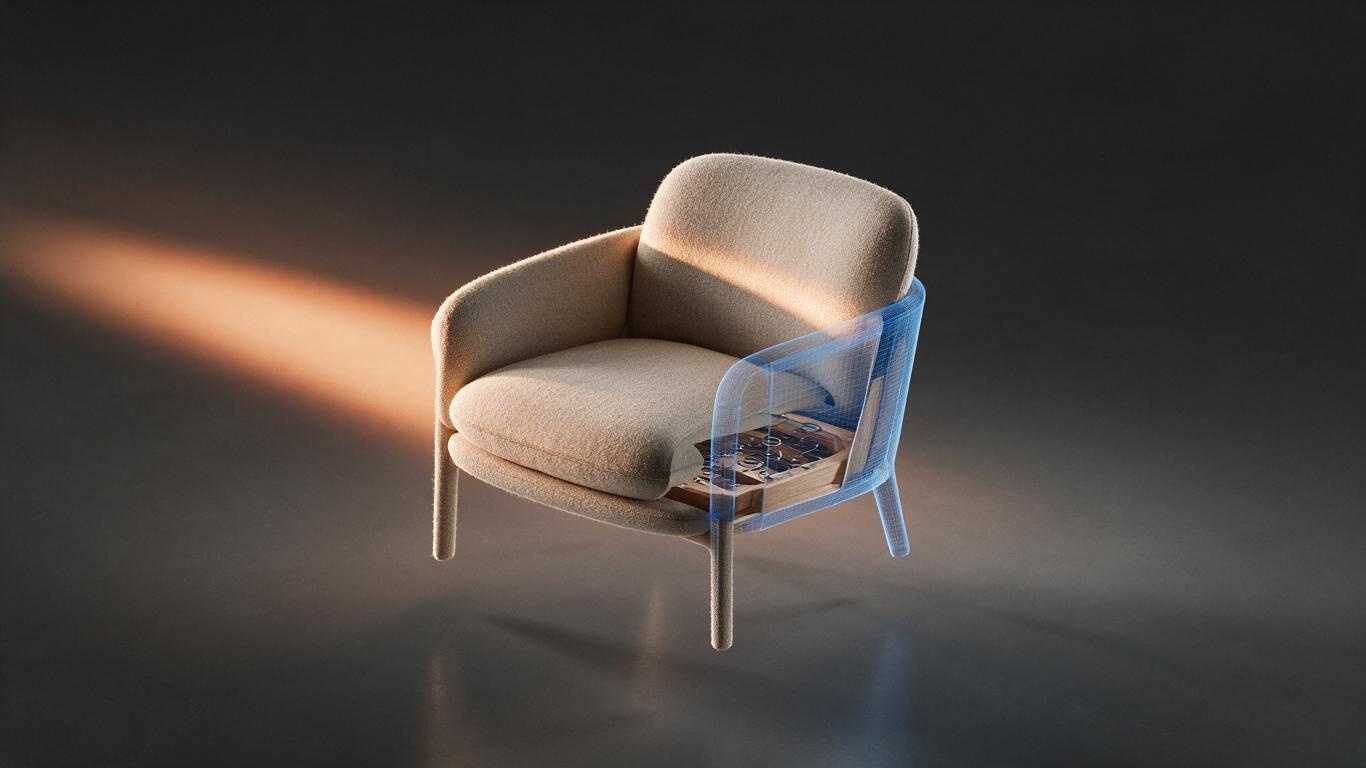
Same product, two completely different outcomes
Here is a simple test. Take one product, put a clean white-background photo on the first screen of a product page, and watch how long people stay — usually about two seconds. Now replace it with a 15-second clip that rotates the product, opens its housing, and lets light travel across the surface. Nothing about the product changed. What changed is what the buyer could actually see.
That gap is exactly what product animation video production is built to close. It turns a static industrial design file into moving images a customer can understand in seconds. This guide covers the definition, the six-stage workflow, where the money goes, and how to choose a studio without getting burned.
What product animation video production actually means
Strip away the jargon and it describes one pipeline: take a product’s shape data — a CAD file, an engineering drawing, or a set of photographs — and rebuild it as a high-fidelity 3D model. Give that model physically accurate materials: the roughness of brushed aluminum, the gloss of injection-molded plastic, the refractive index of glass. Light it so it behaves the way it would in a real room. Then move the camera, open the parts, pour the liquid, detonate the exploded view. Finally render, edit, and score it.
The point is not spectacle. The point is control. A live shoot depends on weather, location, sample condition, and a photographer’s mood. A 3D scene depends on nothing but the file — which means re-rendering a shot costs almost nothing.
That detail matters more than most brands realize. A new colorway, new packaging, a new seasonal claim — all of it is a file change, not a rebuild of the set. If you publish dozens of assets a year, the math eventually tips decisively toward animation.
Three places where it beats live action
First, reach: internal structures, airflow, absorption, transmission — a camera cannot film them, a 3D model can, down to the millimeter. Second, consistency: ten live shots can carry ten different color temperatures, while ten renders share one parameter set and look like they came from the same mold. Third, the cost curve: live-action budgets grow linearly with shot count, while a finished 3D model makes each additional angle progressively cheaper.
Live action still wins on human emotion and messy reality. That is why hybrid pipelines — real people and real environments, with 3D for the product itself — are increasingly the default. For a fuller comparison, see From live action to AI+3D: how the production workflow evolved.
The six stages of a real production
- Brief and script — where the video will run (marketplace listing, brand film, trade-show loop), how long it is, and which three selling points matter. Skipping this step means redoing everything later.
- Storyboard and animatic — locking the camera language before anyone touches final rendering.
- Modeling and texturing — rebuilding the product and assigning PBR materials. Model quality sets the ceiling for everything downstream.
- Animation and camera work — how the product moves, how the lens travels, where the rhythm accelerates. This is where AI changes the economics fastest: a full 3C electronics animation breakdown shows what that looks like in practice.
- Lighting and rendering — the step that decides perceived value. One notch of lighting separates a premium product from a plastic one.
- Post and sound — edit, grade, sound design, subtitles, multilingual voiceover. Cross-border projects typically need three to five language versions.
Pricing and timelines
Typical industry ranges: a single-product 15-second marketplace video runs from roughly $1,000 to $3,000; a 30-second brand film with multiple scenes and difficult materials (liquids, particles, soft cloth) lands between $3,000 and $12,000; industrial and machinery explainers, which require structural cutaways and mechanical logic, usually start around $7,000 and scale from there.
Timelines: 5–10 business days for simple projects, 10–20 for mid-complexity, and weekly scheduling for large productions. What actually drives the quote is never the runtime — it is model complexity, shot count, and revision rounds. Nail those three down before kickoff and you will save more than any amount of comparison shopping.
Choosing a studio: look past the reel
A beautiful reel proves nothing. Plenty of stunning samples took a team three months to polish and bear no resemblance to what a typical project delivers. The questions that matter: how many projects in this exact category have you shipped? Do you reuse models or rebuild from scratch every time? How many revision rounds are included? Do we receive the source project files? Will a packaging refresh trigger a new invoice?
We published a breakdown of the criteria that actually separate vendors — see the four criteria that separate good AI+3D animation vendors. If your catalog is large and refreshes often, also confirm the studio runs a batch pipeline; otherwise every video starts from zero and the price never comes down.
Is your product a good fit?
In practice, if any one of these is true, the return is usually clear: the product has internal structure or a mechanism to explain (machinery, consumer electronics); surface finish is the core premium driver (home, beauty, jewelry); the product is hard to film well (heat-sensitive, water-sensitive, very large or very small); or the line refreshes colors and packaging frequently.
Conversely, if your product is a pure experience service, or its value rests entirely on a human face and voice, live action may be the smarter spend. Tools are not better or worse — only better or worse matched.
Want a read on your own product? Send us the link through our contact page and we will give you the honest assessment first, then talk budget and timeline.