
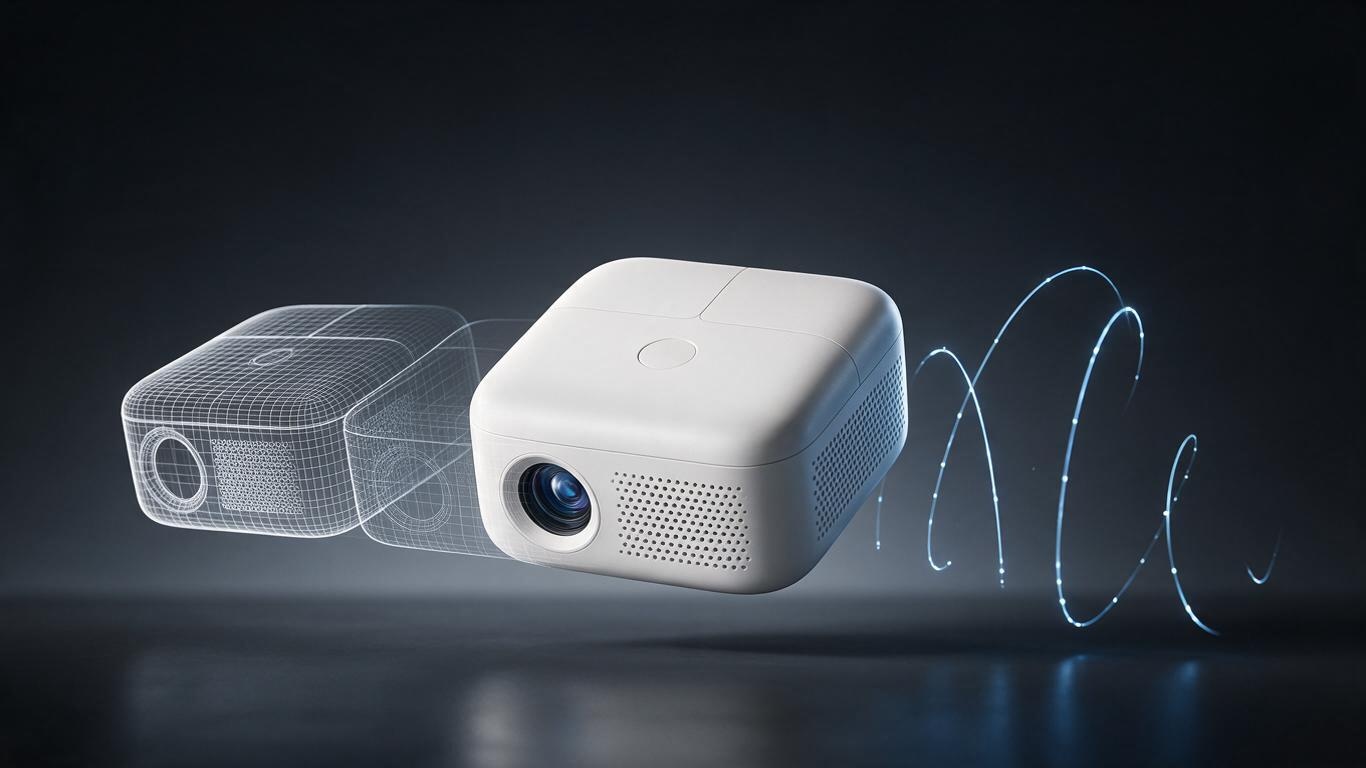
What Are You Really Searching For When You Type "Product Animation Video Production"?
Probably not a textbook definition. The problem on your desk is concrete: you have a product, live-action shoots can't capture its quality, or every reshoot means rebuilding the set, rebooking the studio and paying again — only to end up with footage that looks like everyone else's.
So here is the working definition: product animation video production is the process of building a digital model of a product inside a 3D environment and animating it according to a script, using modeling, texturing, lighting, rendering and — increasingly in 2026 — AI-generated assets. No physical product needs to be on set. No photography studio needs to be rented. Every chamfer, every coating layer, every droplet sliding down the inside of a bottle is fully controllable.
A few years ago this was the territory of big-budget ad films: a 15-second full-CG product spot took three to six weeks and cost more than most brands wanted to spend. Once AI entered modeling, texturing, motion and rendering, the barrier dropped fast. The same perceived quality now ships in five to twelve working days, at a price point most brand teams can buy on a regular basis.
Three Words, All Doing Real Work
Product sets the anchor. Every shot, cut and sound effect serves one thing: the selling point. Water resistance. Noise level. A 0.3-second opening mechanism. A seven-layer composite interior. Animation excels at the things cameras cannot see.
Animation is the technical backbone. It covers model accuracy, PBR material fidelity, lighting, camera motion and pacing. A machine disassembling into twenty-seven parts and reassembling itself, or a beverage exploding into thousands of droplets in slow motion — those are engineering, not cinematography.
Video production reminds us it has to ship as something usable: a main-image video, a feed ad, a looping booth screen, a crowdfunding hero clip. Great studios ask on day one where the video will run, who will watch it, and what they should do next.
Four Formats — Picking the Wrong One Wastes the Budget
Full 3D CG animation. Clean, controllable, capable of dramatic exploded views and cutaways. Best for complex, high-ticket, trust-dependent products: machinery, precision instruments, premium electronics.
AI + 3D hybrid animation. The fastest-growing format. AI assists with base geometry and texture generation, artists refine topology and lighting, then AI drives motion and camera previs. Best balance of speed and control.
Live-action with CG compositing. Real sets, real hands, layered 3D effects. Human warmth plus technical polish — common in beauty, personal care and food.
2D motion graphics. Low cost, great for explaining features and data, but it cannot carry product texture. Don't expect a brand premium from it.
If you are unsure which path fits your category, start with our comparison of live-action and AI+3D workflows.
How It Differs From Traditional Shooting
Control comes first. In live action, bad light means waiting, reflections mean repositioning, a missing detail shot means another studio day. In animation those become parameters: light positions measured in centimeters, reflection intensity to two decimal places, and a camera that can fly inside a product and back out.
Reusability comes second. A 3D project file is an asset library. New colorway tomorrow? Swap the material and re-render. Export markets next year? Change voiceover and subtitles. One model can spawn a main-image video, a booth loop, a crowdfunding film and an AR experience over three years.
Imagination comes third. You can cut an air conditioner open in a living room and visualize airflow as colored particles, turn suction into a vortex, or follow an active ingredient from bottle to skin layer. Those moments are exactly what buyers need to feel certain.
Five Steps in a Real Production
1. Discovery and script. Define channel, length, core benefit and call to action, then write the storyboard. Weak briefs guarantee rework.
2. Modeling and material fidelity. Build from photos, CAD files or physical samples. Reproduce brushed metal direction, micro-texture on plastics, glass refraction and liquid viscosity. This step decides whether the product looks real.
3. Animation and camera choreography. Slow push-ins for premium feel, fast cuts for information density. See how much AI now handles in AI-driven motion generation.
4. Lighting, rendering and compositing. Build the virtual studio, light it, render in passes, then composite, grade, add effects and sound design.
5. Multi-format delivery. Landscape, vertical and square versions for website, marketplace, feed ads and booth screens. One production, many placements.
Pricing: Where the Money Goes
Typical 2026 China market ranges: a 15–30 second motion graphics explainer runs roughly RMB 3,000–10,000; an AI+3D hybrid runs RMB 8,000–30,000; a high-fidelity full-CG product film runs RMB 30,000–150,000; complex simulation or mechanical linkage work goes higher.
Four variables drive cost: model complexity, animation difficulty, render fidelity, and the number of delivered versions. Aligning on a storyboard before comparing quotes will save you a great deal of confusion.
Which Products Should Do This First
Strongest fits: structurally complex but visually plain products (machinery, industrial parts, tools); features that static images cannot explain (water purifiers, smart home devices); high-ticket, long-consideration categories that need trust (3C, health, auto parts); and crowded categories where differentiation is everything (beauty, food and beverage, consumer goods).
Wait if the product is visually minimal, the budget only supports one short campaign, or the design is still changing — animating an unfinalized product is a trap. Before you talk to vendors, read our four criteria for choosing an AI+3D animation vendor and our breakdown of five common product animation pitfalls.
The Short Version
Product animation video production is not decoration. It translates technical advantages into visual language buyers understand instantly and are willing to pay for. Choose the right format and one production can serve five channels for three years — at which point it stops being a cost and becomes an asset.