
1. Start with a Viral Video
Last week, one of our home decor clients (a high-end smart lighting brand) shared some exciting news: a 30-second AI+3D product animation they posted on Douyin garnered over 2 million views, and the flood of inquiries forced their customer service team to work overtime. You might wonder: what's so special about a product video? But if you've seen it—where the light fixture slowly illuminates in a virtual space, with rays cutting through every crystal facet, finally settling into a cozy living room scene—you'd understand that AI+3D product animation is not just a "moving 3D model." It's an entirely new language for brand storytelling.
But wait, what exactly is AI+3D product animation? How is it different from traditional 3D animation or live-action filming? Why are more and more brands (from 3C electronics to beauty, from food & beverage to machinery) turning to it? This article is your complete guide, tailored for brand decision-makers.
2. The Blood and Bones of AI+3D Product Animation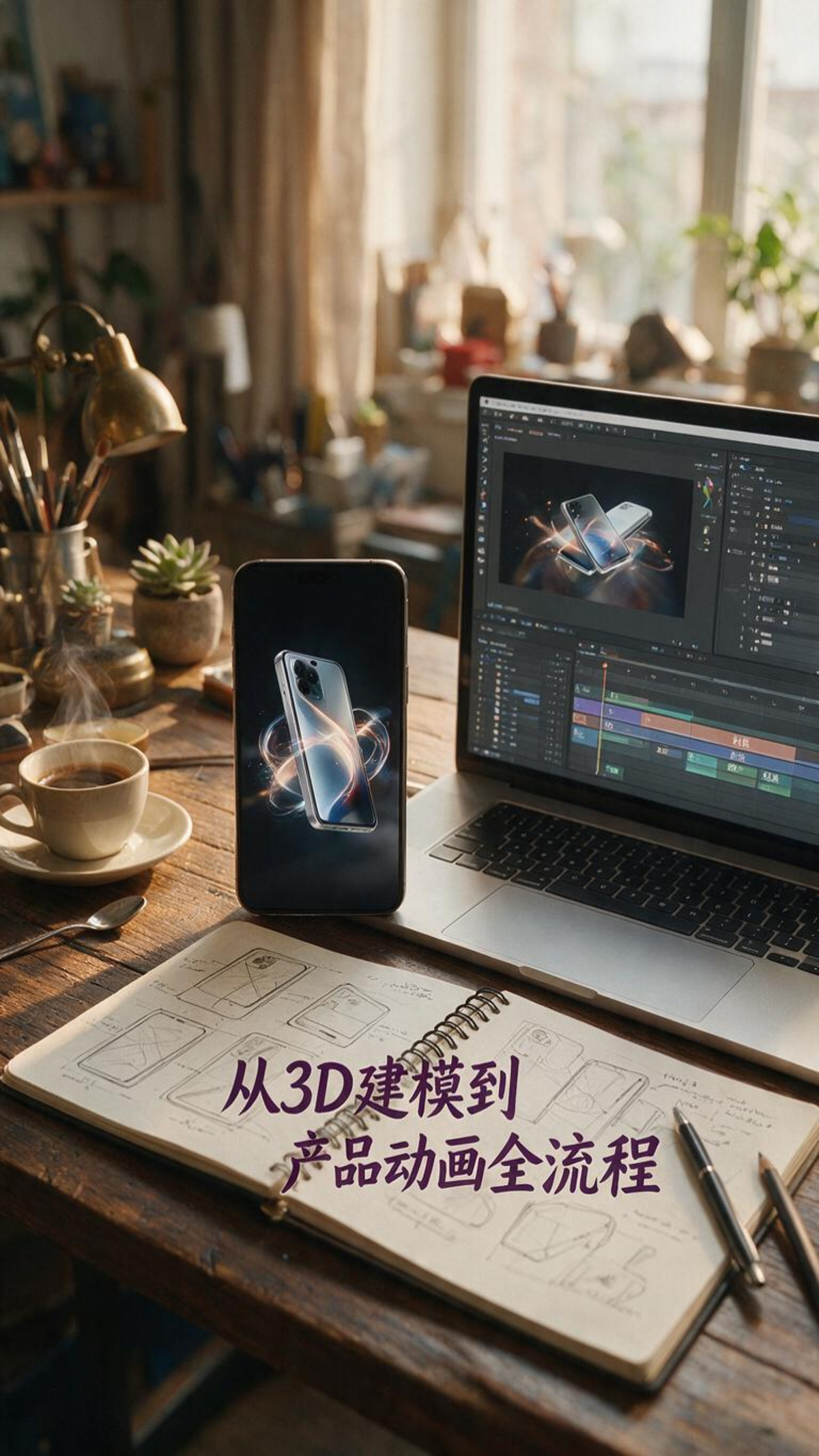
Simply put, AI+3D product animation = 3D modeling & rendering technology + AI-driven automation. Traditional 3D animation requires modellers, animators, lighters, and renderers working together—a 30-second shot can take weeks. AI intervenes to compress much of the repetitive labor (automatic rigging, intelligent motion generation, automated material adjustments).
For example, when we create a rotating display for a smart watch, the traditional workflow would require manual keyframing to make the dial pointer rotate accurately while the case reflects the environment. Now, AI can automatically generate high-precision models from product photos or CAD data, then algorithmically match the optimal motion path, and even recommend lighting schemes based on material properties (metal, glass, leather). The result: production speed 5–10x faster, with cinematic quality.
But this doesn't mean humans are out of the picture. A good AI+3D animation company treats AI as an accelerator, not a replacement. Our workflow: Creative planning (human) → AI-assisted modeling & animation (human + AI) → Manual refinement & color grading (human) → Final rendering (AI + GPU cluster).
3. Why Are Brands Falling for It?
You might ask: "I've already spent hundreds of thousands on equipment, studios, models—why should I switch to AI+3D?" Let's compare head-to-head:
- Cost: A live-action food ad, with venue, props, food stylists, and post-production, costs at least $2,000–$5,000 per clip. AI+3D animation, at the same quality, can be done for $800–$2,000.
- Time: Live-action from prep to final delivery takes 7–15 days. AI+3D animation delivers in 3–7 days.
- Iteration flexibility: Live-action: want to change product color? Reshoot. Change angle? Reshoot. AI+3D: tweak parameters, new version in hours.
- Visual ceiling: Live-action is limited by physics (lighting flares, imperfect reflections, insufficient macro detail). AI+3D can show the product in its perfect state—like bubbles inside a beverage so crisp you can count them, or a machine's internal parts opening like a sci-fi transformation.
More importantly, this capability is no longer exclusive to big brands. In the past, only automakers with million-dollar budgets could afford CGI animation. Now, any small or medium brand can use AI+3D to make their product look like a luxury item.
Which industries benefit most? 3C electronics (phones, earphones, smart devices) are a natural fit—we did a headphone disassembly animation for a Shenzhen manufacturer, boosting their Amazon conversion rate by 3.5x. Beauty & skincare is another perfect match—crystal bottles, serum flow, texture diffusion—AI+3D can achieve the ultimate luxurious feel. Additionally, food & beverage, machinery, furniture, fitness equipment—almost any industry that needs to display product details can win.
4. Three Steps to Start Your AI+3D Animation Journey
If you're tempted to try, don't rush into buying software or contacting vendors. Follow these three steps:
- Define your purpose: Main image video on Amazon? Short-form content on Douyin/Xiaohongshu? Product page on your official site? Different channels have different requirements for duration, aspect ratio, and density.
- Prepare core assets: Product images (multiple angles), videos (if any), CAD models (bonus), brand guidelines (colors, logo). High-quality inputs help the vendor understand your product quickly.
- Find the right partner: Don't just compare prices. Check if their portfolio includes work in your category. Can they clearly explain how they use AI? Do they have clear delivery timelines and revision policies? A mature product animation studio should produce a rough script and animatic within 1–2 days.
5. Common Myths Debunked
We've heard so many misconceptions—let's clear them up:
- ❌ “AI+3D looks fake, like a video game.”
✅ In 2026, AI+3D rendering achieves photorealistic quality, especially with ray tracing and volumetric lighting—indistinguishable from live-action footage. - ❌ “It can only do simple rotating demos.”
✅ Complex mechanical disassembly, liquid flow, cloth simulation, and even human-product interaction can be handled by AI combined with physics engines. - ❌ “Small companies can't afford it.”
✅ Smaller companies need it most to close the visual gap with big brands. A $300 AI+3D video might generate $30,000 in sales growth.
We tell our clients: don't think of AI+3D product animation as "special effects." It's essentially an industrial production tool for product visuals. In the past, making a great product video was like handcrafting a porcelain vase; now with AI+3D, it's like an assembly line—more output, higher consistency, lower barrier.
6. Your Decision Checklist
Before writing this, I reviewed over 50 projects we delivered this year. There's a pattern: the brands with the best results all did three things: prioritized creative planning, provided quality source materials, and trusted their vendor's expertise. If you want to try it out, start with a simple product rotation video to experience the speed of AI+3D.
If you have more questions—like "what's the exact production process" or "how is pricing calculated"—don't worry, we'll break them down in upcoming articles. For now, bookmark this page. Next time your team is discussing, just send the link and say: "This is exactly what we need."