
Project Background: The Brand Premium Battle Behind a Serum Bottle
In March 2026, a premium Chinese beauty brand focused on "Oriental Herbal Tech Skincare" approached us. Their hero product — an anti-aging firming serum priced at ¥529 — was selling simultaneously on Douyin (TikTok China), Tmall, and Amazon.
The core dilemma: the product itself was excellent, but the visual presentation couldn't match the price point.
"We invested three years in product R&D. The formula benchmarks against international luxury brands' ¥1,500+ product lines," the founder told us. "But when users see our product images — a transparent glass bottle with pale gold liquid against a white background — it just looks like a bottle of water. They can't feel the quality that ¥529 should command."
Even worse, during livestreams and short videos, when the host held the product up to the camera, the bottle reflections and liquid transparency were nearly invisible under harsh streaming lights. The brand's "premium feel" was completely lost in the streaming quality gap.
The problem wasn't the product — it was that traditional visual methods cannot reproduce the true texture and quality of beauty products.
We proposed an AI+3D product animation solution: replacing traditional product photography with cinematic 3D-rendered animations, so consumers feel "this is premium skincare" the second they open the product page.
The Unique Visual Challenges of the Beauty Category
Beauty and skincare products face distinct visual challenges in e-commerce:
| Pain Point | Traditional Solution | AI+3D Animation Advantage |
|---|---|---|
| Small products, abundant details | Macro photography (expensive, complex lighting) | 3D renders can magnify/rotate freely, revealing every detail |
| Liquids/creams are hard to shoot | High-speed photography + manual mixing | AI fluid simulation accurately reproduces serum flow and cream texture |
| Glass/acrylic reflections | Repeated lighting adjustments (2-3h per product) | AI auto-analyzes material optics, generates optimal lighting in one click |
| Brand tonality communication | Relies on scene construction and props | AI generates brand-exclusive visual styles, from color to atmosphere |
| Streaming quality dependency | Depends on host equipment, uncontrollable | Pre-rendered 3D animation maintains premium quality in any streaming environment |
Full Pipeline Breakdown
Step 1: Product Analysis & Brand Tonality Positioning
After receiving the product, we thoroughly analyzed its material composition and brand tonality:
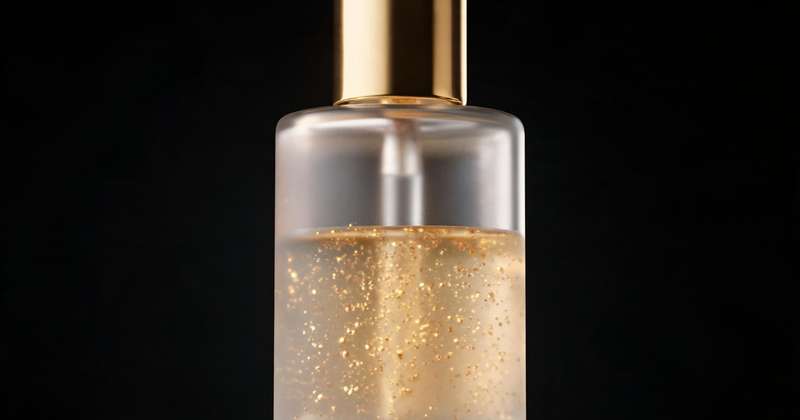
- Bottle: Frosted gradient glass (clear→matte transition), gold cap, dropper design
- Contents: Pale gold viscous serum with suspended microcapsule particles
- Brand keywords: Oriental aesthetics, tech-powered skincare, power of nature, premium feel
- Target audience: Urban women aged 25-40 who value quality and will pay for the "experience"
Based on the analysis, we defined the core visual strategy: Using light, shadow, and material simulation to tell the visual story of "nature's power captured in a bottle." Suspended microcapsule particles as the visual focal point, and the subtle refraction of golden liquid through glass as the texture anchor.
Step 2: AI-Assisted 3D Modeling & Texturing
The core difficulty in beauty product 3D modeling lies in translucent materials and multi-layer refraction:
- Bottle glass must simultaneously show transmission (seeing internal liquid), reflection (seeing environment light), and refraction (seeing glass thickness)
- The matte gradient from clear to frosted requires precise control of roughness map gradient distribution
- Microcapsule particles suspended in liquid require physics simulation for authenticity
We used AI tools to dramatically accelerate the material phase:
- AI glass material generation: Input "borosilicate glass, thin wall, pale gold UV-protective coating" — AI auto-generates precise IOR (refractive index 1.52), transparency, and dispersion parameters
- AI gradient matte mapping: Based on bottle curvature, AI auto-generates roughness gradient from 0% to 60%
- AI liquid material: PBR parameters for viscous serum — high-viscosity Subsurface Scattering parameters, pale gold Absorption Color — all generated by AI using physics-based models
- Microcapsule particle system: AI particle system simulates 500+ microcapsules suspended in liquid, slowly rotating and colliding, creating authentic internal texture
Traditional manual material creation for beauty products takes 7-10 days; AI assistance compressed this to 2.5 days.
Step 3: 3D Animation & Cinematography
Beauty product animation rhythm needs to be "slow" — every movement should give viewers time to immerse themselves in the exquisite lighting and textures. We designed 5 shot sequences for the 30-second serum animation:
Shot 01 (0-6s) · Opening: Brand Ritual
- Against pure black, a soft warm golden light beam slides down, the bottle emerges slowly from the light and shadow
- Camera pushes in from profile to 45° front, the frosted gradient glass reveals rich layers under side lighting
Shot 02 (6-12s) · Core: Microcapsule Floating Aesthetics
- Camera pushes into the liquid inside the bottle — 500+ pale gold microcapsule particles slowly float, suspended, gently rotating
- Light penetrates the liquid, microcapsule surfaces catch subtle highlights — like a starry sky
- This is the product's biggest visual differentiator: "visible active ingredients"
Shot 03 (12-18s) · Function: Dropper Extraction
- The dropper slowly rises from inside the bottle, serum forms a full droplet at the tip
- AI fluid simulation demonstrates the droplet viscosity — slowly deforming, stretching, finally falling
- The droplet lands on a skin-like textured surface, slowly spreading to demonstrate spreadability and absorption
Shot 04 (18-24s) · Scene: Oriental Aesthetic Atmosphere
- Product placed in AI-generated Oriental aesthetic bathroom/vanity scene
- Morning light streams through bamboo blinds onto the bottle, warm natural light blends with product's golden tone
- Swaying botanical shadows subtly visible in background — echoing the "herbal" brand DNA
Shot 05 (24-30s) · Closing: Brand Freeze Frame
- Bottle slowly rotates to face the camera head-on, all microcapsule particles converge toward center
- Brand logo and product name fade in at center
- Final freeze at the perfect 45° product showcase angle
Step 4: AI Scene Generation & Atmospheric Lighting
Scene context is critical for beauty products — it directly determines where the brand sits in consumers' minds. We used AI scene generation to create three complete atmospheric setups:
① Oriental Natural Aesthetic (Tmall/Little Red Book): Bamboo blinds light-and-shadow, natural stone countertop, dewy green plants as soft foreground — echoing the "Oriental Herbal Tech" brand positioning
② Modern Minimalist Lab (Brand Website): Clean white laboratory space, minimalist metal counter, precise cool lighting — highlighting the "tech-powered skincare" product essence
③ Luxury Vanity (Amazon/International): Warm gold marble countertop, silk-textured background draping, soft candlelight ambiance — communicating the "Premium Skincare" luxury positioning
All three scenes are generated from the same AI+3D asset set, with near-zero marginal cost, yet provide the brand with differentiated visuals for different platforms and markets.
Step 5: Post-Production & Multi-Platform Output
AI-assisted post-production included:
- Quality enhancement: AI super-resolution upscales render output to 4K 60fps, removing residual noise from glass material rendering
- Color grading: AI palette analysis extracts brand VI colors (gold + white + warm grey), auto-applied to overall grading
- Multi-platform adapted output:
- 16:9 4K — Tmall/Amazon main image video
- 9:16 — Douyin/TikTok short video
- 1:1 — Little Red Book/Instagram
- Subtitle versions — CN/EN/JP auto-generated
Results
60-Day Performance Comparison
| Metric | Before | After | Change |
|---|---|---|---|
| Product page CVR (Tmall) | 2.3% | 7.1% | +210% |
| Average order value | ¥458 | ¥641 | +40% |
| Avg time on page | 28s | 76s | +171% |
| Return rate | 5.8% | 2.1% | -64% |
| Douyin organic views | Baseline (~5K) | Peak 470K | Explosive growth |
The Most Strategically Significant Change: Average Order Value and Brand Premium
What we care most about isn't the conversion rate — it's the 40% average order value increase.
Why? Because AI+3D animation fundamentally changed the consumer's perception of the brand. After watching the animation, users' perception shifted from "a bottle of serum" to "this is premium skincare." The ¥529 price point was no longer "expensive" — it became "worth it."
The brand founder later told us something that stuck with us: "The most important thing AI+3D animation did for us wasn't selling more products — it was making our products look like they deserved to sell for more."
Why the Beauty/Skincare Category Is Naturally Suited for AI+3D Animation
1. Product Texture = Brand Value
The core selling point of beauty products often isn't functionality (how quickly can you feel anti-aging effects) — it's the usage experience and emotional value. AI+3D animation can perfectly present every sensory detail from unboxing to application — something static images can never achieve.
2. Glass + Liquid = 3D Rendering's Absolute Advantage
Beauty products extensively use glass bottles, droppers, and pump dispensers — materials with multi-layer refraction and reflection that are extremely difficult to capture perfectly in real photography. 3D rendering engines can precisely simulate every refraction path, presenting textures more "perfect" than reality.
3. Brand Differentiation Heavily Depends on Visuals
Beauty is one of the categories with the highest brand premium. Products made with the same formula in the same factory sell for ¥89 from Brand A and ¥529 from Brand B — the difference is almost entirely brand perception. And building brand perception through visuals is the most direct and effective approach.
4. Fast SKU Iteration Requires Efficient Visual Production Lines
Beauty brands launch dozens of new products/new packaging/limited editions every year. Traditional photography teams need sustained time investment, whereas once AI+3D animation establishes category templates and material libraries, the marginal cost for subsequent new products drops dramatically.
5. Content Is Naturally Social-Media-Ready
Beauty product 3D animations inherently carry a sense of "premium quality" and "watchability," making them highly suited for social media platforms like TikTok, Little Red Book, and Instagram. Our experience: the social media virality of beauty AI+3D animation far exceeds other categories.
Recommendations for Beauty/Skincare Brands
- Don't just make product images — make "product experience videos": Let users begin "experiencing" your product the second they open the page — floating microcapsules, flowing serum, spreading cream
- Brand-exclusive visual language: Use AI to generate 3+ scene styles with different tonalities, establishing consistent brand recognition across different platforms
- Empower livestreaming with animation: Embed AI+3D animation segments into livestreams as "product demonstration moments," compensating for the quality loss of product texture during live streaming
- Start with hero SKUs, then expand: Begin AI+3D animation with your highest-priced, highest-decision-barrier flagship products to establish the "premium brand" perception first
Ready to create cinematic product visuals for your beauty/skincare brand? Contact us for custom AI+3D product animation solutions and pricing.