
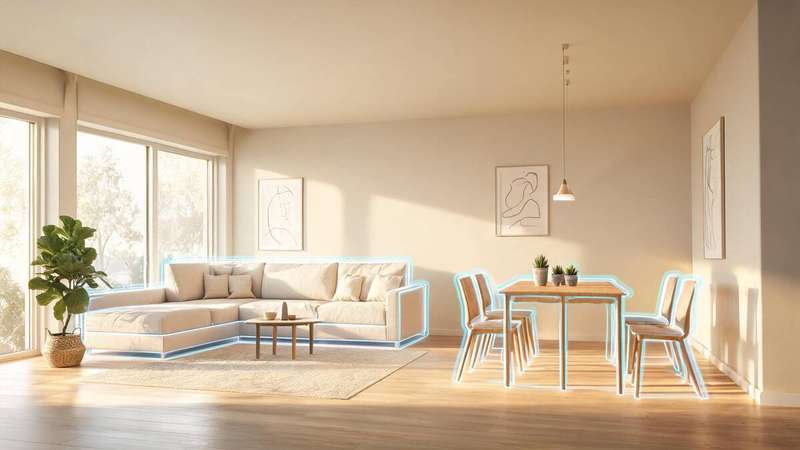
Project Background: A Nordic Design Brand's E-Commerce Dilemma
In autumn 2025, a "minimalist Nordic style" home furnishing brand approached us.
Their product line covers solid wood dining tables, modular sofas, bookcase systems, lighting, and decorative objects. They have stores on JD.com, Tmall, and Pinduoduo, while also testing overseas markets through AliExpress and Amazon.
The problem was straightforward: online conversion rates were stuck.
"We've already invested heavily in product photography," their e-commerce lead told us. "We hired professional furniture photographers, built lifestyle sets, created scene shots. But users still ask endless questions after looking at the photos: 'What's the leather quality really like?' 'Will this table match my living room?' 'It looks huge — will it actually dominate my space?' Our customer service team spends half their day just answering these questions."
Even more frustrating was the return rate. Large furniture return logistics are extremely expensive, and over 60% of returns cited "didn't match expectations." Users ordered thinking it would feel "premium," only to find it was "just average" upon delivery.
This wasn't a product problem — it was the inherent limitation of static images to convey "volume" and "material quality".
Our recommendation: Replace traditional scene photos with AI+3D product animation as the main product page video.
Why Furniture & Home Goods Need AI+3D Animation Most
The unique characteristics of the furniture category make 3D animation more essential than for any other product type:
| Pain Point | Traditional Solution | AI+3D Animation Solution |
|---|---|---|
| Can't see material quality | Multi-angle detail shots (5-10 images) | Animated macro shots reveal material texture, with light revealing true quality |
| Missing sense of scale | Add reference objects (books, vases) | Animation naturally transitions between spatial scales, letting the brain establish proportion automatically |
| Can't feel the atmosphere | Physical set building (expensive & limited) | AI generates multiple home style environments — from Japanese to Nordic to Industrial — in one click |
| Don't understand functionality | Text + icon explanations | Animation shows modular sofa assembly/disassembly, extendable table unfolding dynamics |
| Unsure about color/material | Shoot each SKU separately (costs multiply) | AI auto-generates multiple color/material variants, switchable in one click |
The core purchase decision for furniture — "Will it look good in my home?" — requires spatial imagination. Static images struggle to provide this, while 3D animation can build complete spatial understanding in 15 seconds.
Full Pipeline Breakdown
Step 1: Pre-Production & Shot Planning
We selected 3 core products with the brand for the first batch of animations:
- Modular Sofa (3-seater + corner) — Brand flagship, highest price point, highest decision barrier
- Solid Wood Extendable Dining Table — Strong functional highlight (adjustable length), perfect for animation
- Magnetic Track Lighting System — High-tech feel, dynamic effects shine visually
We designed 3 narrative lines for each product:
- Functional Line: How sofa modules connect/separate, how the table extends, how track lights slide magnetically
- Atmosphere Line: Overall visual presentation in different home style environments
- Texture Line: Macro material details — solid wood grain rings, fabric weave patterns, brushed metal reflections
Step 2: AI-Assisted 3D Modeling & Texturing
The challenge with furniture 3D modeling lies in model complexity and material diversity:
- A dining table = tabletop (solid wood) + legs (metal) + extension rails (metal) + hardware
- A sofa = frame (solid wood) + cushions (foam + fabric) + back pillows (down) + sofa feet (metal)
Each material has completely different optical properties. This is where AI shines:
- AI PBR Material Generation: Input "Nordic white oak, matte clear coat finish" — AI auto-generates matching Base Color, Roughness, and Normal maps, simulating authentic wood luster and grain direction
- AI Fabric Simulation: Sofa fabric weave patterns, wrinkles, and draping effects are auto-generated by AI through physics simulation engines — no more manual ZBrush sculpting
- AI Auto UV Unwrapping: For irregularly shaped furniture parts (curved sofa armrests), AI optimizes UV layout to minimize texture stretching
Traditional manual modeling + texturing takes 5-7 days per product. AI assistance compresses this to 2 days per product.
Step 3: 3D Animation Production
Furniture animation demands are fundamentally different from 3C products — it must be "slow".
3C electronics animation pursues fast-paced, high-tech energy with 2-3 shot transitions per second. Furniture animation requires slow, steady, ceremonial pacing — every camera push must give viewers time to absorb spatial layout, material texture, and lighting changes.
Our shot design:
Modular Sofa Animation (30s):
- Shot 01 (0-8s): Empty living room scene emerges from soft light, sofa modules glide in from off-screen and assemble
- Shot 02 (8-15s): Camera slowly pushes in, revealing fabric texture and cushion plumpness, sunlight through blinds casting shadows across the sofa
- Shot 03 (15-22s): Module separation demo — 2-seater + corner + ottoman freely combinable
- Shot 04 (22-30s): Transition to evening ambiance, floor lamp illuminates, family watches a movie on the sofa, brand logo fades in
Solid Wood Extendable Table Animation (25s):
- Shot 01 (0-6s): Table appears in compact form, surface wood grain clearly visible under side lighting
- Shot 02 (6-12s): Tabletop slowly extends outward on both sides, center leaf rises from within and locks into place
- Shot 03 (12-18s): Camera orbits 360° around the table, showing form from every angle
- Shot 04 (18-25s): Table placed in complete dining room scene — tableware, wine glasses appear sequentially, pendant light casts warm glow
Magnetic Track Light Animation (20s):
- Shot 01 (0-5s): Ceiling track emerges from blur to clarity, light heads slide along rail via magnetic attachment
- Shot 02 (5-12s): Lights activate — heads project beams from various positions, demonstrating customizable illumination zones
- Shot 03 (12-20s): Color temperature smoothly transitions from 2700K warm yellow to 5000K cool white, demonstrating stepless tuning
Step 4: AI-Driven Scene Generation
This is the most distinctive aspect of furniture animation — scenes.
A dining table placed in a bright minimalist dining room versus a moody industrial loft evokes completely different emotional responses. Traditional photography requires renting studios, building sets, and setting up lights — expensive and style-limited.
AI scene generation has fundamentally changed this:
- Input 3D model → AI auto-generates matching interior scene: Analyzing product style (Nordic), AI generates corresponding living/dining room 3D scenes from its training library
- Auto-generated HDRI environment lighting: AI automatically matches the most suitable HDRI lighting scheme to the scene style
- Multi-style one-click switching: The same sofa can freely switch between Nordic, Japanese, Industrial, and Minimalist environments — four sets of scene photography costs compressed into one AI+3D asset production fee
"This isn't simple background replacement," our technical director emphasized. "AI-generated scenes are complete 3D environments with correct perspective, proportions, and lighting. The light interaction between product and scene is physically accurate — that's fundamentally why users feel it 'looks real.'"
Step 5: Post-Production & Multi-Platform Output
In post-production, we leverage AI for:
- AI Super-Resolution Enhancement: Upscaling render output from 1080p to 4K while removing render noise
- AI Auto Multi-Language Subtitles: Generating CN, EN, JP subtitle versions simultaneously
- AI Multi-Aspect Ratio Output:
- 16:9 — Product detail page main video
- 1:1 — Social media (Instagram/Little Red Book)
- 9:16 — TikTok/Douyin short videos
- 21:9 — Website hero full-width background
One set of AI+3D animation assets covers every distribution channel.
Results
Online Performance (60-Day Post-Launch Data)
| Metric | Before | After | Change |
|---|---|---|---|
| Product page CVR (Sofa) | 1.8% | 5.2% | +189% |
| Product page CVR (Table) | 2.1% | 5.8% | +176% |
| Avg time on page | 38s | 82s | +116% |
| Return rate (large furniture) | 11.2% | 4.7% | -58% |
| Customer service inquiries | Baseline | -42% | Major decrease |
The Two Most Compelling Numbers
- Return rate down 58% — This was the number that moved the brand most. Animation let users "experience" the product before purchase, managing expectations so the "disappointment gap" upon delivery shrank dramatically.
- Customer service inquiries down 42% — Previously getting hundreds of daily questions like "What's the material really like?" and "Will it look good in my home?", users now understand everything from the animation. CS workload halved.
The brand's e-commerce lead later told us: "AI+3D animation isn't a cost — it's a tool that saves us return costs and customer service costs."
Unexpected TikTok Viral Breakthrough
An unexpected win came from TikTok.
We uploaded the vertical version (9:16, 30s) of the sofa animation to the brand's TikTok account — zero ad spend, pure organic posting. The results:
- Organic views exceeded 800,000 within 72 hours
- 32,000 likes, 1,600 comments
- Comments flooded with "Is this real? It looks too realistic" and "Where can I buy this?"
- The video drove 2-3x daily search visitors to the Tmall store
This opened a new traffic channel for the brand — AI+3D animation is content in itself. It's not just a tool to assist selling; it drives sales on its own.
Why Furniture & Home Goods Uniquely Need AI+3D Animation
Looking back at the entire project, we believe the furniture/home category is uniquely suited for AI+3D animation:
1. High-Stakes Decision, Low-Frequency Contact
People don't buy furniture every day. Decision cycles are long, considerations are many. A 60-second animation can establish complete understanding at first contact.
2. Large Items, Sky-High Return Costs
Return logistics for a single sofa can cost 300-500 RMB. Every 1% reduction in return rate from AI+3D animation, for a brand with 50M RMB annual revenue, translates to 150K-250K RMB in saved return costs per year.
3. Many SKUs — Production Efficiency is Competitive Advantage
A furniture brand may have dozens to hundreds of SKUs. AI+3D batch production capability can cover the entire product line at extremely low marginal cost.
4. Strong Cross-Scene Display Needs
The same piece of furniture performs completely differently in different home styles. AI-generated multi-style environments let consumers "see this furniture in their preferred style" — something traditional photography can never achieve.
5. Content Marketing Arsenal
One set of AI+3D animation = Tmall main video + JD video + Amazon video + TikTok + Little Red Book + WeChat Official Account + in-store display screens. Seven birds, one stone.
Recommendations
If you're in the furniture/home industry, here are three immediately actionable suggestions:
- Start with your flagship products: Select 3-5 core SKUs for AI+3D product animation first. Evaluate data results before deciding to expand across the entire product line.
- Scene variety is your core selling point: Don't do just one scene — let AI generate 3-5 different home style environments. Seeing the same furniture across different settings dramatically boosts purchase confidence.
- Animation is content, content is traffic: Deploy AI+3D animation simultaneously to e-commerce platforms and content platforms. One asset, dual-channel monetization.
Ready to create cinematic AI+3D animation for your furniture and home products? Contact us for professional solutions and pricing.