
The folder called “corporate_video_final_REAL_final”
Every marketing team has one. Three files: six seconds, thirty seconds, and three minutes and eight seconds. Eighty percent of the footage is identical — the same factory exterior, the same production line close-ups, the same founder pointing at a whiteboard. The company paid three times, ran three site visits, and still got asked in a group chat why the three voiceovers sounded like three different companies.
The problem was never the budget. It was that nobody asked, before the cameras came out, how many versions we actually need and what each one is for.
Definition: the deliverable of corporate video production is a version matrix
Corporate video production is the creation of moving-image assets that explain a company’s capabilities, products and credibility to external audiences. Its real deliverable is a set of assets, not a single film. The same set of brand facts gets cut into versions that differ in length, channel and viewing context: a loop for the trade show booth, an autoplay hero for the website, a file a salesperson sends on WeChat, an attachment inside a tender document, a paid-social clip that has two seconds to stop a thumb.
Call that set a version matrix. It has one governing rule: capture the underlying facts once, then layer the level of detail by channel. Draw the matrix during planning, not after the edit — the time you save upfront gets paid back with interest in post.
The 6-second cut: a visual hook, not a story
The six-second version is routinely mistaken for a trimmed 30-second edit. It is not. Its job is not narrative; it is to stop a scrolling thumb.
That makes the planning brief the strictest of the three. One fact, one motion, one focal point. A robotic arm completing a single precise pick. The damped click of a lipstick cap closing. Condensation beading on a bottle pulled from ice water. No company name three times, no “empowering the future through technology,” and often no people at all.
The script looks more like a storyboard card than a screenplay: an opening frame, a motion, an end card carrying the brand name and a descriptor under eight characters. Its KPI is completion and recall, not information density.
The 30-second cut: website hero, dealer meetings, paid social
Thirty seconds is the most-used and hardest version to write. It has to establish who you are, prove you can do it, and tell the viewer what to do next.
A structure that holds up is problem — capability — evidence. Spend the first five seconds on a situation the customer actually recognises (not an industry macro-trend; a specific situation, like “every changeover costs four hours of downtime”). Spend fifteen seconds showing capability, and it must be visible: machine motion, product structure, inspection data. Close with ten seconds of evidence and an end card — a certification, the industry spread of your client list, one concrete number.
Before locking this script, read it once with the voiceover muted. If the images alone don’t carry it, the shooting plan is the problem, not the copy. The same principle runs through our breakdown of how brands should choose an AI+3D animation vendor.
The 3-minute cut: the trust document for audits, tenders and showrooms
The three-minute version lives in very specific places: pre-audit introductions before a client visits the plant, technical annexes in a tender, the five minutes a visitor sits down in your showroom, and the substitute for a live intro when time zones don’t line up.
Its job is trust, not reach. So it is allowed to be slow. It can show the factory floor, the inspection logbook lying open on a bench, an engineer pausing slightly while explaining a process step. In advertising logic those are wasted frames; in trust logic they are the evidence.
Structure it as: who the client is — where they get stuck — how we solve it — why believe us. The fourth act is the centre of gravity and should take over forty percent of the runtime: production line, inspection, delivery records, after-sales response time, and people. The faces are the part most likely to be cut, and the part that should never be.
One planning round, one shoot day, three versions fed
The economics of a matrix come from reuse. Planning happens once: list every filmable proof point the company owns, then tag which version each point serves. Scripting forks: all three versions draw from the same fact list at different granularity. Shooting consolidates: one lighting setup per location, captured wide for the three-minute cut, medium for the thirty, tight for the six and for thumbnails.
A practical shoot day runs like this. Morning on the line: three passes with the camera — wide to establish environment, mid to capture operation, macro for detail. Afternoon for people and interviews, recorded against a question bank so a single answer can be repositioned across versions. Delivery then outputs a spec table listing aspect ratio (16:9, 9:16, 1:1), duration, subtitle language and end-card rules per asset.
The approach is well established in live-action work; the asset-reuse logic is identical to what we described in our full breakdown of a 3C product animation project, except the reused asset there was three-dimensional.
Put the product chapters in AI+3D and re-versioning costs drop by an order of magnitude
Product chapters are usually the expensive part of the matrix. Shooting a physical product means lighting it, controlling temperature, wiping fingerprints between takes; a colour change restarts the process, a spec change restarts the set build. And product change is exactly what happens most often: a new generation, a new colourway, a new parameter, an extra vertical cut.
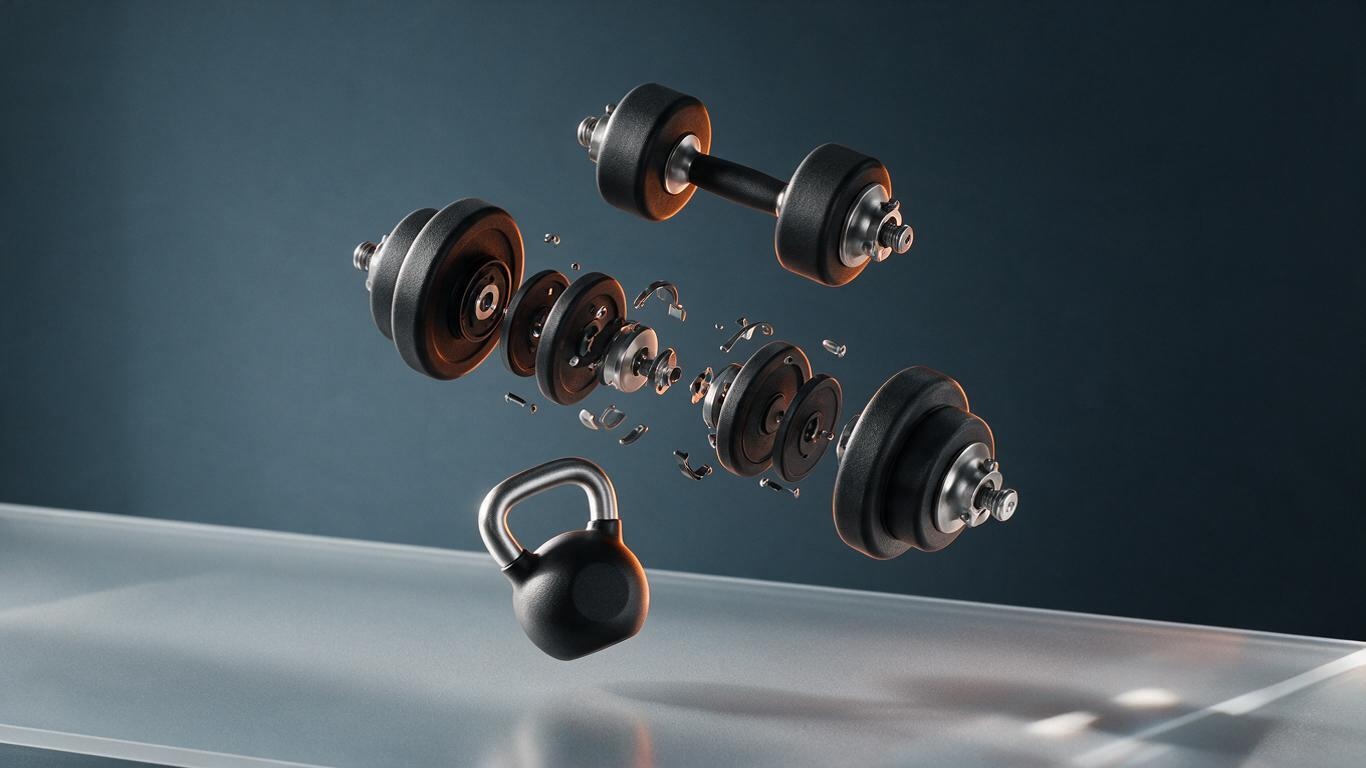
AI+3D product animation changes the logic. The product is built once in three dimensions; after that, camera angles, aspect ratios, durations, colourways and exploded views are parameters. The six-second cut grabs the instant of separation, the thirty-second shows assembly logic, the three-minute places the product inside the wider production context — three outputs, one build. That is why more manufacturers and consumer brands are pulling product chapters out of the live shoot entirely; our comparison of live action and AI+3D pipelines covers the process in more detail.
The boundary deserves saying plainly: AI+3D is strong on products, structures, mechanisms and data visualisation, and weak on replacing real people, real factories and real handshakes. A healthy matrix is usually hybrid — live action for the humans, 3D for the products, stitched together by one editing rhythm and one grade.
Three questions that reveal whether a vendor delivers a matrix or a single film
Ask these before signing anything.
One: “Will you give me a version list during planning?” If they open with shooting days instead, they are assuming one film.
Two: “If we change the product colourway, do we reshoot?” A yes means your product cost scales linearly with every iteration. A “change the parameter and re-output” is what an asset-building partner sounds like.
Three: “What does your delivery spec look like?” A vendor who can produce a table of aspect ratios, durations, languages and subtitle rules has been burned by channel adaptation before. One who can’t will have you chasing a sixth vertical cut in a group chat.
The real professionalism in corporate video production isn’t in the title sequence. It’s in how clearly the matrix was drawn before anyone picked up a camera. If you want to sketch yours, contact us and we’ll start with the list, not the shot.