
It's 2 AM, and you're staring at the 4th version of your product video on screen—still no proper lighting on the gray-scale model, and the glass bottle's reflection looks like a mess. This is the third time you've asked the designer to re-do it, but Amazon Prime Day goes live in three days. You rub your temples and suddenly realize: if only there were a magic pipeline that could automatically generate cinematic product footage.
This isn't a joke. Over the past two years, at least 70% of the 300+ brand clients we've served had similar painful experiences before finding us. Some spent $7,000 on flat photography only to be charged extra for video. Others outsourced to traditional CGI studios—$11,000 for a 30-second animation with a 20-day turnaround, and after three revisions the result still fell short.
So what exactly is product animation? Simply put, it's using digital technology to make a product 'move'—rotate, disassemble, x-ray, change materials, even simulate real liquid flow inside a virtual bottle. But product animation in 2026 isn't the 'cheesy 3D showreel' you used to see. The integration of AI has completely rewritten the rules.
Breaking it down, product animation includes five essential elements: Model (the digital twin of your product), Material (simulating real-world metal, plastic, glass, fabric), Lighting (cinematic atmosphere), Animation (motion path, exploded views, function demos), and Rendering (output to final video). In the traditional workflow, each step required a senior 3D artist to manually tweak—timelines in weeks, budgets in tens of thousands.
But the AI+3D workflow has compressed the entire chain by 70%. For example, when we made a Bluetooth earbuds animation for a Shenzhen 3C brand, traditional methods would take 5-7 days modeling + 3 days lighting + 2 days rendering + 1 day post-production = 13 days total. With AI, we generated the model directly from photos, applied AI pre-set lighting scenes, used AI motion libraries for animation, and delivered in just 3 business days. The result? That earbud's click-through rate on Amazon jumped 2.3x.
You might ask: can any product be animated? Absolutely. From delicate jewelry to massive industrial machinery, from flowing juice to flickering circuit boards, the only limit is imagination. Our wildest case: a 5-meter tall mining crusher. The client thought they'd have to shoot on location. Instead, AI+3D not only recreated the internal gear connections but also simulated the rock crushing process from intake to output—something impossible to film without cutting the machine open.
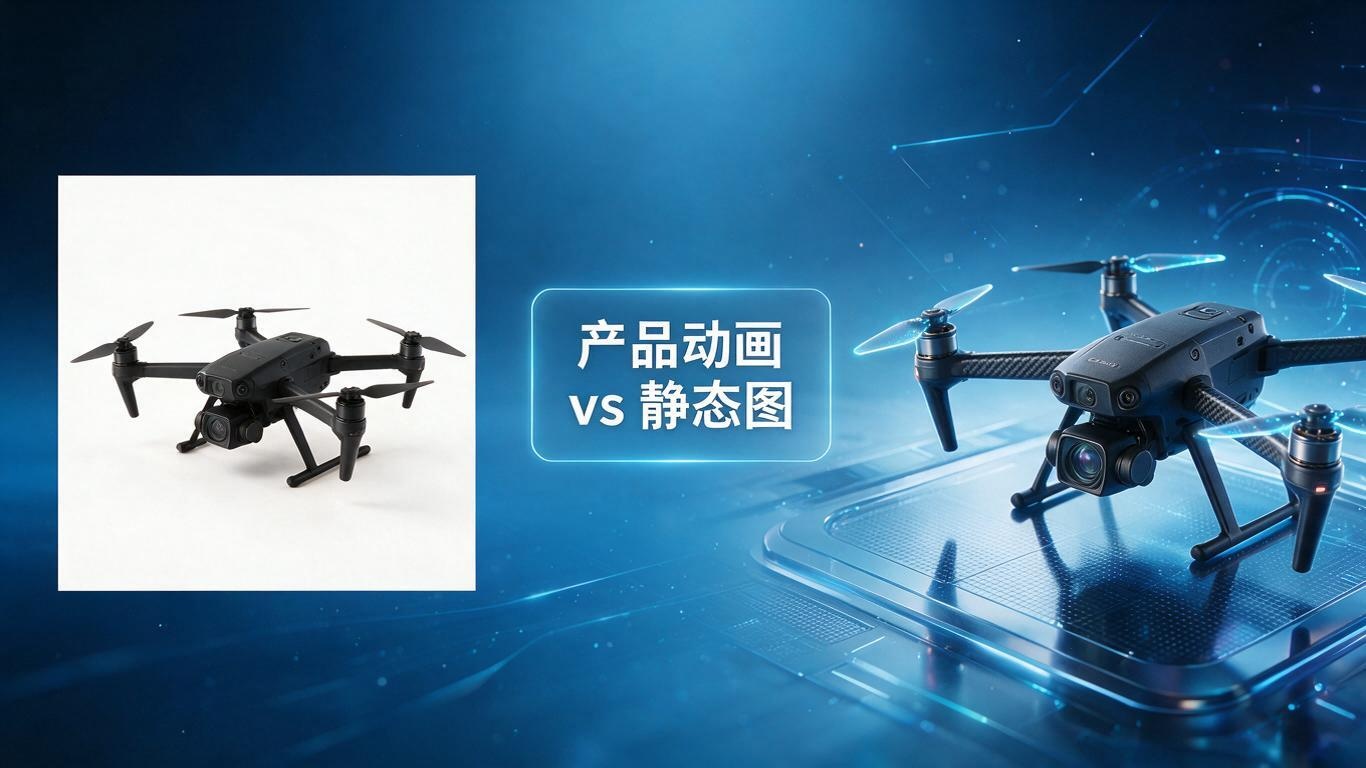
More importantly, in 2026 product animation has shifted from 'nice-to-have' to 'must-have for survival'. Major e-commerce platforms (Amazon, Temu, TikTok Shop) increasingly favor video content: product main image videos convert at an average of 47% higher than static images (according to our client statistics). If your competitors are using dynamic showcases while you're still struggling with white-background photos, the gap is Nokia vs. iPhone.
Want to see a full 3C case study? Click here for our Bluetooth earbud animation breakdown.
Product animation isn't magic, but it's quickly becoming the sharpest knife in the modern brand marketing toolbox.


