
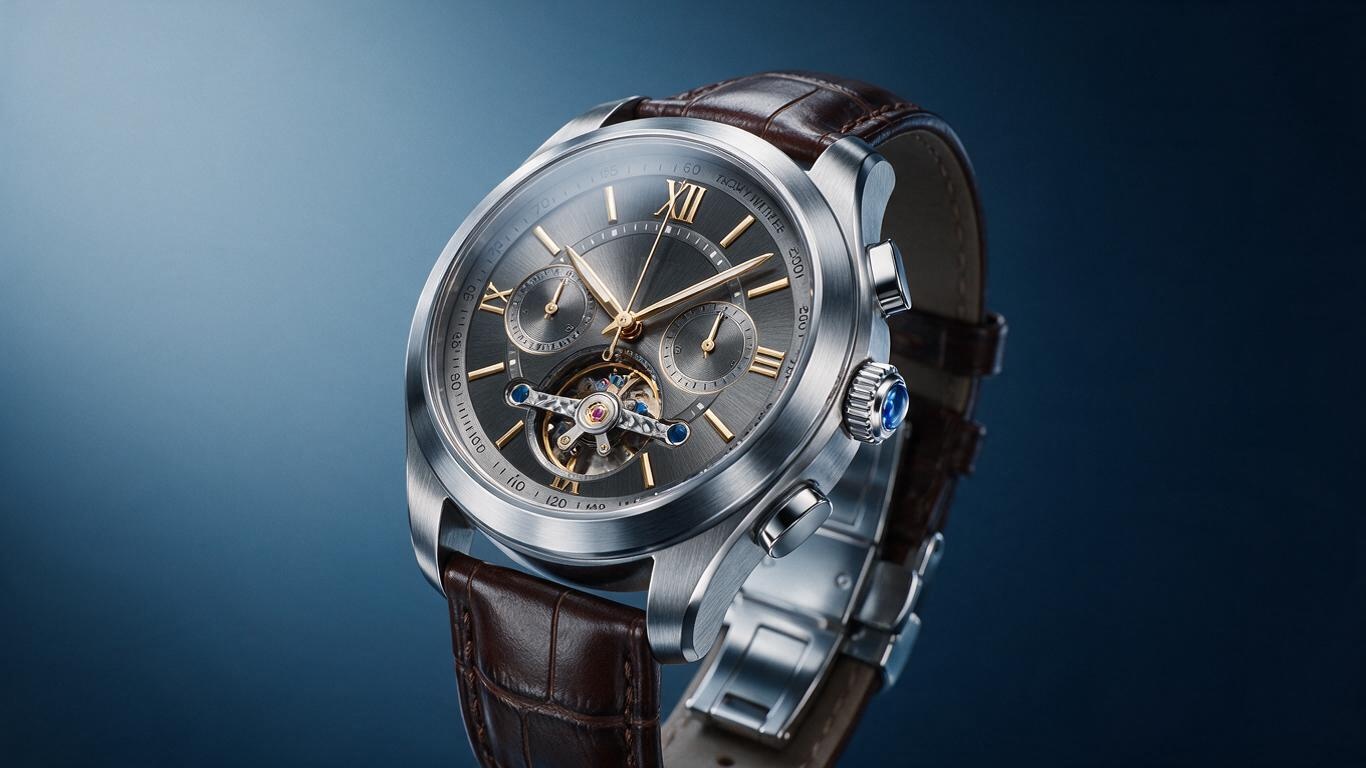
Last week I visited an old friend who runs a watch business in Shenzhen. His office was filled with dozens of watches—every single one worth at least five figures. But when I pulled out my phone to snap a few shots, the photos looked dull and lifeless. Gold appeared plastic, sapphire crystal became a reflective blur. He sighed: "That's our e-commerce team's pain. Customers can't touch the product, but rely on a few static images. Conversion rates are stuck."
I asked: "Have you tried AI+3D product animation?" He scoffed: "That's an expensive game for big brands." I smiled, pulled a USB drive from my pocket, and plugged it into his computer. On screen was a 30-second animation we had just completed for another watch brand—gears meshing, seconds ticking, dial tilting as light swept across, the bracelet swaying slightly in natural daylight.
He watched in silence for five seconds, then asked: "How much…?" When I told him the price, he immediately called his operations manager: "Cancel next week's photo shoot. Switch everything to 3D." This isn't a made-up story—in the past six months, we've received inquiries from over a dozen luxury accessory brands: watches, jewelry, sunglasses, handbags. Why? Because the visual bottleneck for fashion accessories is painfully obvious.
Traditional live photography for accessories is incredibly challenging. Macro shots require extreme precision with lighting—one reflection mistake ruins the whole image. Dynamic display is nearly impossible—you can have a model rotate her wrist with the watch on, but details get lost. More importantly, a single main image can only gamble on one angle, while users want to see "how it looks on". AI+3D animation solves all these problems. Take a multifunctional mechanical watch we handled: Phase one—high-precision scanning plus AI model completion, restoring the 316L stainless steel case, sapphire crystal, carbon fiber dial to 0.01mm tolerance. Phase two—setting up three layers of lighting in a virtual scene (key, fill, rim light) to create a "sweeping light" effect on brushed metal textures during rotation. Phase three—using an AI-driven physics engine to simulate movement, with the second hand jumping and the escapement mechanism following along—so realistic that even watchmakers gave their approval.
You might think: this technology must be expensive? Actually, total cost is only 30%~40% of traditional high-end product video. The key is workflow restructuring—AI replaces about 70% of manual parameter tuning, such as automatic material matching and motion trajectory generation. Final deliverable was one 30-second hero video plus five 15-second angle-switching clips, used on Amazon, TikTok, and the brand's website. The client recorded that with the same click-through rate, average dwell time jumped from 8 seconds to 23 seconds, and add-to-cart rate increased by 120%. No special effects—just making the watch "alive" on screen.
The visual competition for fashion accessories is no longer about "who shoots sharper", but "who can give the product a soul in the virtual world". The core logic of AI+3D animation is: redefine reality with computational aesthetics. If you're still struggling with product images for new launches, maybe it's time to consider a different approach. After all, users have limited attention—give them a moving, textured, story-telling display, and they'll gladly stay a little longer.


