
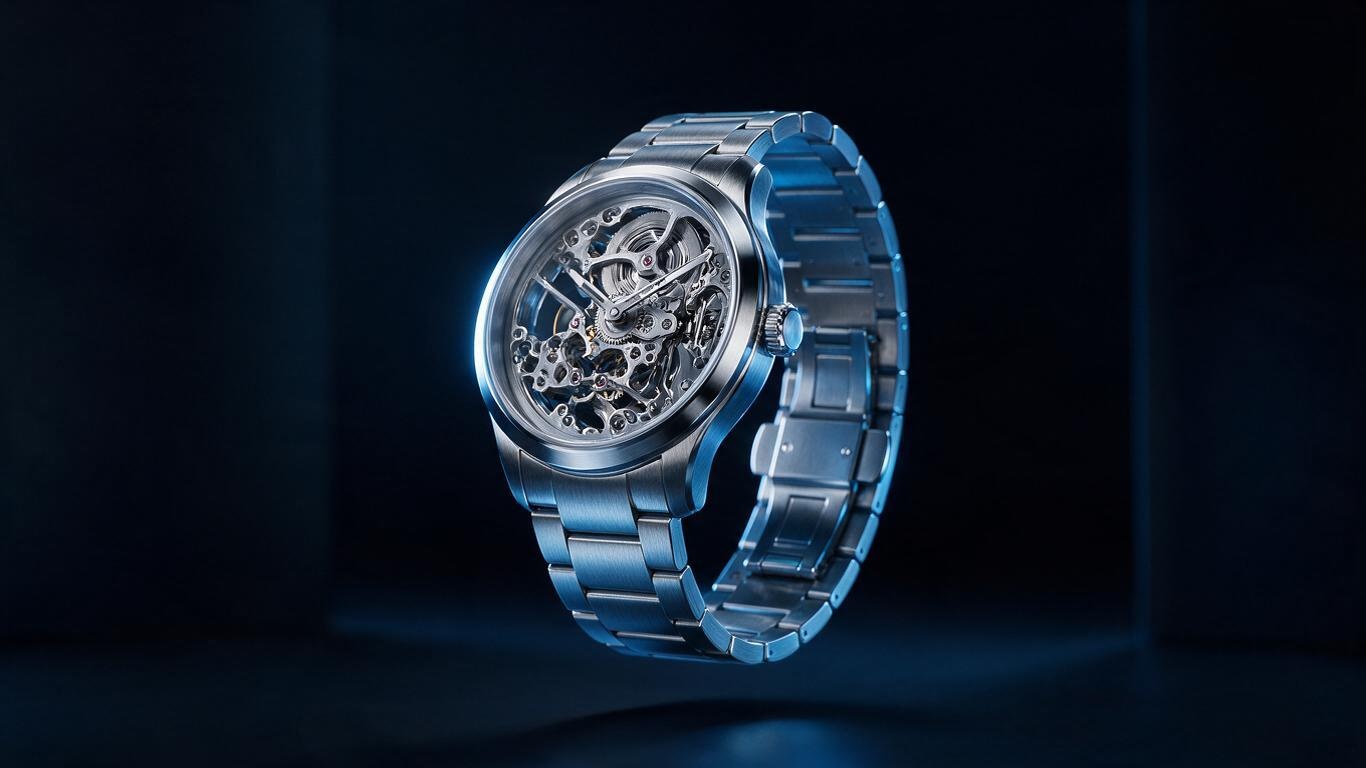
One afternoon in Hangzhou, Lao Zhou placed a mechanical watch on the table. “Why do my customers say my product photos look like they’re from a street stall?” he asked. He had been selling watches online for eight years, and the quality was real—but the listing design couldn’t convey it. I’ve heard this many times.
What we created is a perfect ecommerce product animation example. Instead of rushing into modeling, we studied the watch’s key selling points: the open-worked movement, the sapphire crystal, the steel bracelet. The product wasn’t the problem. The problem was that users couldn’t see it clearly through a screen. A moving 3D animation can turn “can’t see” into “want to see more.”
Traditional filming would require renting a studio, setting up lights, and shooting close-ups of parts—one movement could take a whole day, not to mention dust, reflections, and flaws. But with an AI+3D workflow, we took the watch apart digitally: gears, balance spring, pallet fork, bearings—every part can be freely explored by the camera. You can even explode the movement and reassemble it on screen. This kind of storytelling is simply impossible with static images or even live-action.
From model to finished film
During the modeling phase, we used AI-assisted generation for the watch case and bracelet, then manually refined the chamfers and dial details. The real challenge was materials: the steel bracelet needed a brushed texture, the sapphire crystal needed clear reflections, and the movement gears needed that oily, metallic sheen. If the materials aren’t right, even an expensive watch looks like cheap plastic.
For the motion, we gave the movement real mechanical logic: the second hand ticks once per second, the pallet fork oscillates at 28,800 times per hour, and the gears rotate according to precise transmission ratios. Every frame in the video can withstand scrutiny from watch enthusiasts. The final 52-second film includes sweeping shots of the full watch, macro shots of the movement’s rhythm, and ends with a 5-second lifestyle shot on the wrist of an Asian model (black hair, dark eyes), bringing the product back into a real context.
What one animation changed
Lao Zhou placed the animation at the top of his product page, replacing the old static hero image. After a month, his feedback: average dwell time increased from 18 seconds to 47 seconds, bounce rate dropped significantly, and inquiries from customers asking “does the actual product match the video?” decreased by roughly a third. More surprisingly, two B2B inquiries came in directly because of the video—buyers said, “After watching it, we knew this factory has real capability.”
What impressed me most about this ecommerce product animation example wasn’t the technology—it was the shift in thinking. The client didn’t need a spinning product. They needed a story that explains why a good product costs what it costs. Lao Zhou later asked if we could create a similar animation for a non-stick pan, showing its cross-section and heat conduction. Of course we can—this logic applies to kitchenware, digital products, beauty, furniture, and just about everything.
If you’re hesitating about whether to make an animation for your product, don’t start with “Is my category suitable?” Start with “What invisible advantage does my product have?” If you want a broader view of visual trends, check out our 2026 Ecommerce Visual Trends Report for more inspiration.
As for Lao Zhou’s watch, it’s now the “signature video” in his Moments. He said he finally found someone who could turn his treasure into the customer’s treasure. I like that.