
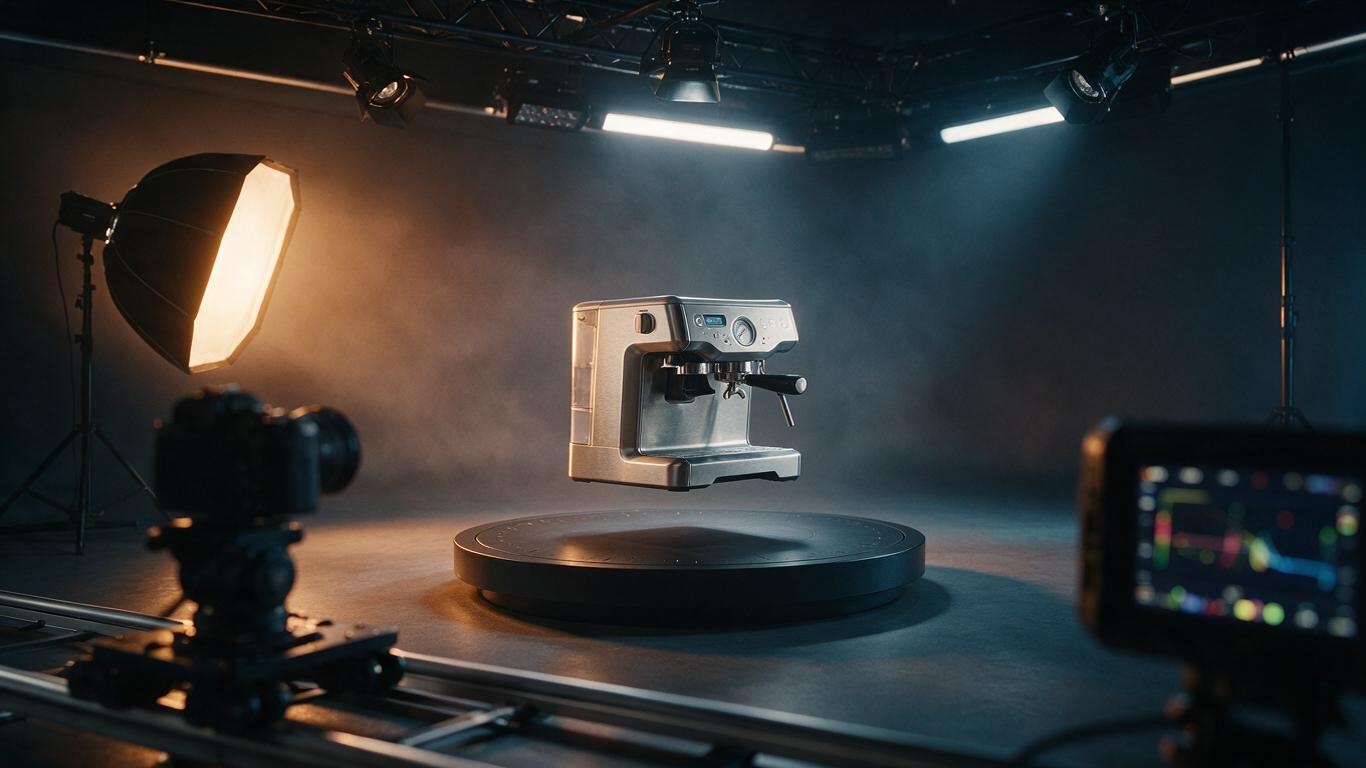
“So, ARTSKY studio — you guys make movies, right?”
We have heard that question hundreds of times. Three minutes into a call, a new client will politely check: ARTSKY studio sounds like a film company.
Strictly speaking, we do not make films. What we make is AI+3D product animation — modelling, animation, rendering and finishing for a coffee machine, an electric toothbrush, a CNC machine or a bottle of serum, delivered for e-commerce listings, short-video feeds, DTC homepages and trade-show screens. Products have nothing to do with cinema, yet the word “studio” has stayed on our door since day one.
So this post is the explanation we have owed for a long time.
Cinema grammar, product purpose
When the team was small, a lot of our early work was traditional live-action product shoots: building sets, lighting, hiring hand models, renting kitchens, wiping water marks off glass again and again. A full day of shooting might yield twenty usable seconds. That was when we realised clients never ask for footage — they ask to look worth buying.
And “looking worth buying” is directorial work. Where the light comes from, at which second the product should stop rotating, how fast the camera pushes in, when the sound enters — those decisions use the same grammar as film. That is why the studio took a film-studio name rather than a rendering-shop name. It is a reminder that a product film is a directed piece with shot design, pacing and staging, not a slideshow of renders with a music bed.
Why “studio” and not “animation”
When we named the English side of the business, the internal debate was real. ARTSKY Animation is plain and easy to explain. We chose ARTSKY studio instead, because animation is only part of what we deliver. A studio is a creative unit — modelers, texture artists, animators, lighting artists, editors and sound. Clients talk to a studio; they do not want to talk to an assembly line.
“ARTSKY” itself breaks into Art and Sky: craft, and the ceiling we keep trying to reach. It sounds idealistic, but a creative team without some idealism ends up simply shipping files.
What that means inside a real project
A standard AI+3D product animation runs through: script and selling-point breakdown → storyboard and animatic → modelling and texturing → animation and camera work → rendering → compositing, grading and sound. Modelling and rendering used to eat most of the schedule. AI has compressed both — a generative pipeline can turn reference images into usable geometry that we then retopologise and re-UV by hand, cutting a week of modelling down to two or three days. We documented that process in our AI 3D modeling workflow breakdown.
But faster is not the same as automated. Which frame deserves the close-up, which feature deserves slow motion, whether the last three seconds should hold the logo — those calls are still human. The machine makes the image cleaner; people make it more convincing.
From the first film to the hundredth
This year we passed one hundred delivered product animations, spanning consumer electronics, food and beverage, machinery, furniture, beauty and personal care, and hardware tools. We reviewed the numbers in 100 product animations in 187 days. What is funny is that after a hundred films, clients still ask the same question — “so you make movies, right?” — except now it is usually followed by: “could you make one for us?”
Three questions clients ask most
First, how is pricing calculated? It depends on model complexity, shot count, duration and render quality — there is no single price list. Second, how long does it take? A standard 15-30 second product animation takes roughly 5-10 working days from approved script to delivery. Third, how many revisions? Two rounds at storyboard stage and two at final cut — an arrangement we consider fair on both sides.
If you are choosing an animation vendor for the first time, start by checking whether their case studies sit in your category, then look at how transparent their process is. We laid out the criteria in the four dimensions that decide an AI 3D vendor.
A name is a starting point, not packaging
ARTSKY studio is less a logo than a working standard: product imagery made to a cinematic bar. If you have a product that should look worth buying on a listing page, a big screen or a three-second scroll, get in touch. You do not need a brief for the first call — just bring the product.