
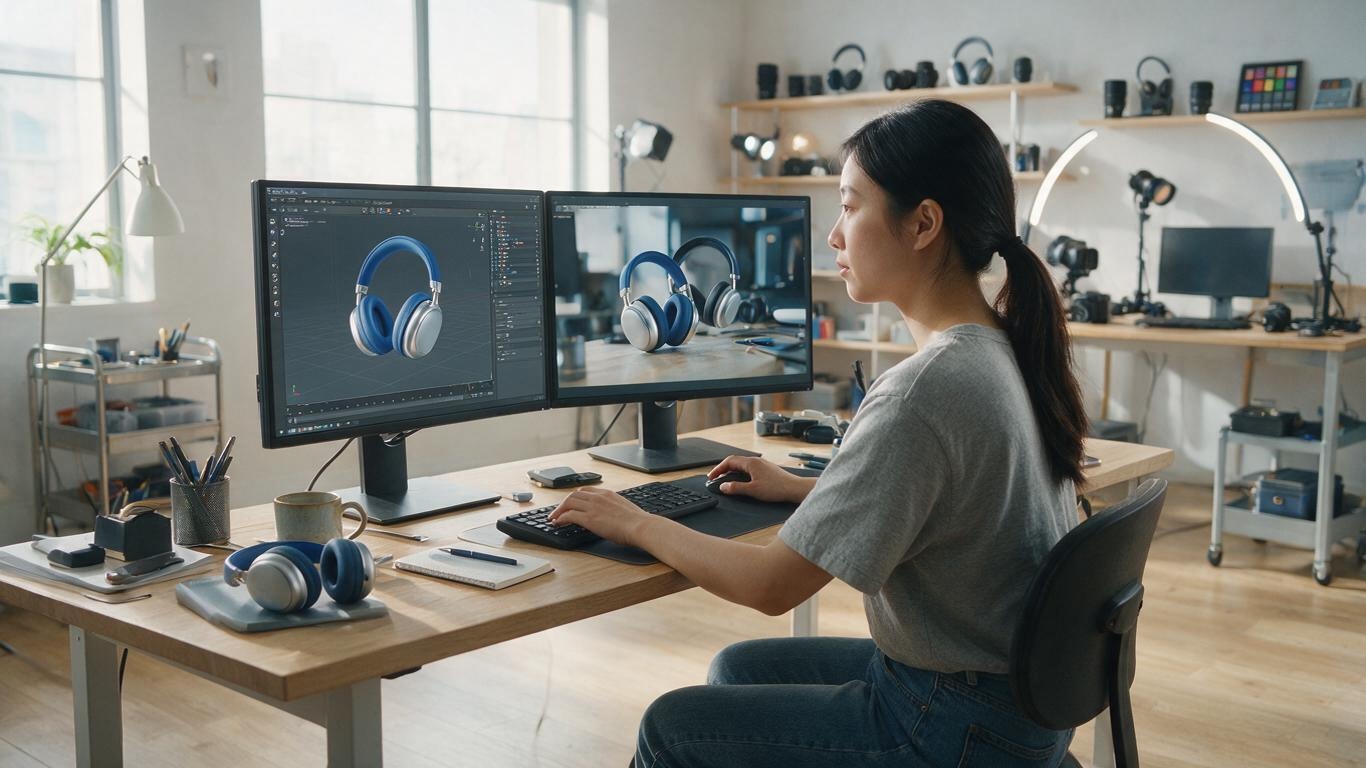
Have you ever been in this situation: a new product is about to launch, your marketing team is pushing for a product video, but the live-action shoot is booked out for weeks, and your budget only covers one angle. At this point, 3D product animation might save you — but the question is, can it really replace live-action?
Let's not jump to conclusions. 3D product animation uses 3D modeling and rendering to create product showcase videos in a virtual environment, and the product can even be a prototype that hasn't been mass-produced yet. Traditional live-action, on the other hand, films the real product with cameras, relying on lighting, props, and post-production to create texture. They operate in different dimensions, but both aim to sell the product.
When it comes to cost, many people assume 3D is always expensive. Actually, that's not true. The biggest cost drivers for live-action are venue, equipment, crew, and props — a complex shoot can easily run tens of thousands of dollars. With 3D, the upfront investment in modeling is real, but once the model is ready, changing backgrounds, colors, and angles is effortless, and the marginal cost of generating additional images or videos approaches zero. If you have multiple SKUs or plan a series of marketing assets, the upfront cost gets quickly amortized. One of our clients, a camping gear brand, used 3D to create a full set of animations for over a dozen products, and the per-product cost was less than half of what live-action would have been.
What do live-action teams fear most? Unpredictable weather, venue issues, product scratches, and lighting that refuses to behave. Filming glass reflections can take hours; capturing liquid splashes relies on high-speed cameras and luck. In the world of 3D, physics obeys you. Want a slow-motion fluid shot? Want an explosion view? Want to break the product down into its components? All it takes is a few clicks. Even better is consistency — replicating identical lighting and scenery across a product series in live-action is nearly impossible, but in 3D you simply reuse the scene, and every product gets the same shading, background, and angles, instantly creating a cohesive series feel.
So when should you choose 3D, and when should you stick to live-action? My advice: if your product is a functional industrial machine, a complex electronic device, or a sample that hasn't been manufactured yet, 3D is the better choice. For example, the animation we made for a precision CNC machine clearly illustrated the internal gear movements and cutting processes — something live-action simply cannot achieve. Conversely, if your selling point is the tactile authenticity of materials — like pure cotton T-shirts or leather sofas — live-action has more persuasive power. That said, many smart brands opt for a hybrid: live-action for close-ups and textures, 3D for conceptual scenes. If you're curious about controlling light and texture, check out our earlier article Lighting Techniques in Product Animation on making 3D look photorealistic.
Here's a simple decision framework: choose 3D if your budget is tight but your SKU count is high; choose 3D if you need fast iteration; choose 3D if your product has complex internals that need to be highlighted. On the flip side, choose live-action if your product relies heavily on genuine texture and touch, especially for limited editions; choose live-action if the brief calls for real-set interaction with people. Of course, if you want both efficiency and quality, the safest move is to work with a team that can handle both approaches and recommend the right one for your product.
In short: 3D product animation isn't a replacement for live-action; it's a more flexible and controllable visual language. Choose wrongly and even the flashiest tech won't help; choose right and cost becomes your advantage. I hope this comparison helps you avoid unnecessary detours. If you're stuck on budget and timeline, feel free to reach out — tell us about your product, and we'll help you decide which route suits you better.


