
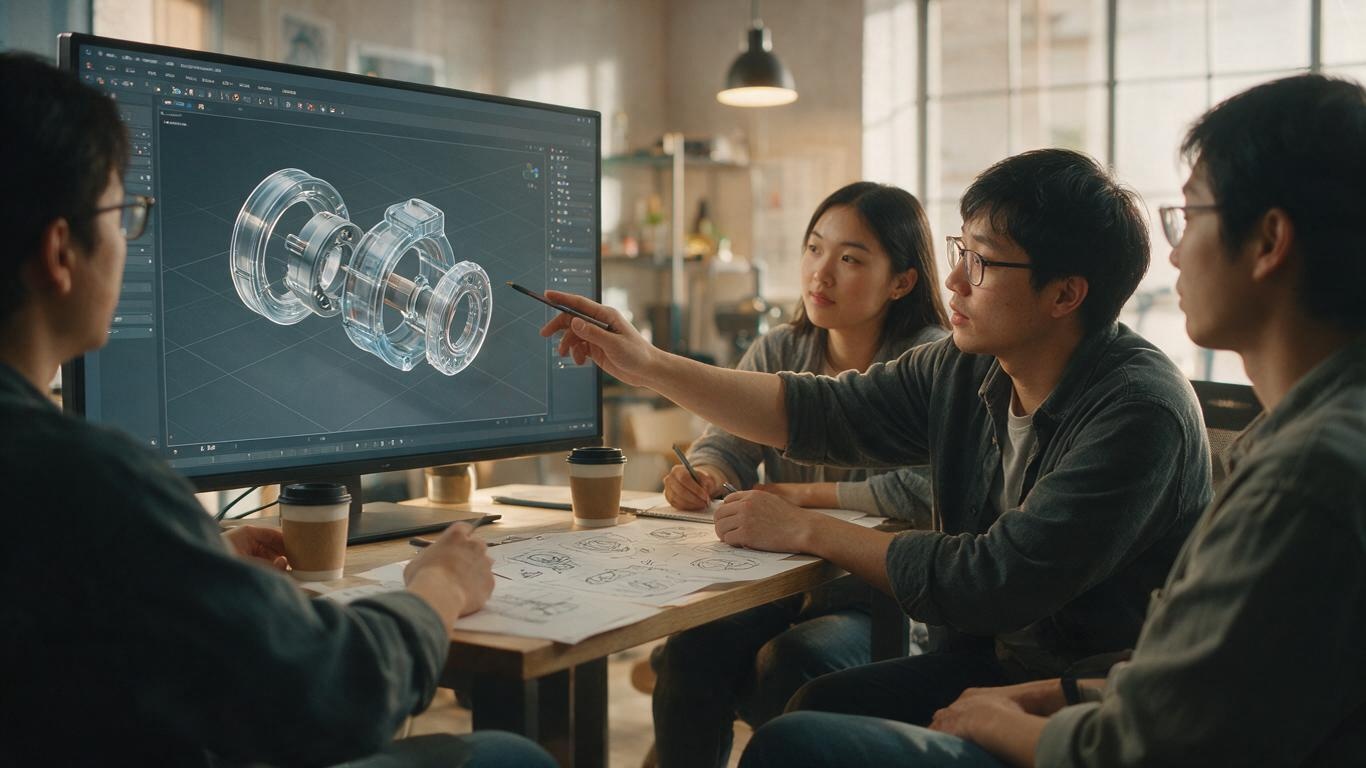
At 9:30 a.m., someone is already pulling frames in our Shenzhen studio. On the monitor, a close-up of a gear turning in 3D—the metal surface catching light so cleanly it almost reflects the room. I walk past with my coffee while A-Kai, our animation lead, is staring at the timeline. One frame dropped, and he's trying to figure out whether it's a render setting issue or the model's polygon count. This is the daily life of our product animation team.
Our product animation team is small—just 12 people—but it's fully equipped. A project manager handles client communication and requirement breakdown; modelers turn product drawings into high-fidelity 3D assets; animators breathe life into the models; lighting and rendering artists make every frame look like a commercial; and the final compositor adds sound, subtitles, and rhythm. If you ask me what matters most in a product animation team, my answer isn't 'better tools'—it's division of labor. When everyone focuses on one thing they're great at, both speed and quality go up.
Last month, we took on a smartwatch project. The client wanted a 15-second product animation delivered in three days. Honestly, in a traditional 3D studio, that timeline is nearly impossible. But since we're an AI-powered product animation team, our workflow is different: AI generates the initial model and motion options, animators fine-tune, and GPU nodes handle the rendering. We sent the first cut by the afternoon of day two. The client replied, 'This is exactly the direction.' Moments like that remind me that the real value of a product animation team isn't spending more hours—it's using a structured pipeline to remove uncertainty.
This approach wasn't built in a day. Earlier this year, we set a record of delivering 12 product animations in 30 days—you can read the full recap in 30 Days, 12 Product Animations. That intense sprint forced us to standardize every step: 'animators must give feedback within one hour after AI generates the first draft,' 'failed renders retry automatically.' Boring rules, but they became the backbone of our internal playbook.
We also have an unofficial ritual: every Friday afternoon, the whole team stops and takes turns sharing a new 'unofficial trick' they've experimented with. Last week, our lighting artist showed us how to use an AI tool to add ambient occlusion to a product in minutes—a task that used to take two hours. The group chat exploded, and suddenly everyone was digging through their own projects to try it. That kind of internal drive makes us feel less like a vendor and more like a product animation lab.
If you're thinking about building or hiring a product animation team, my advice is: don't just look at the demo reel. Ask how they divide work, how they plan timelines, and how they blend AI with human craft. A great team isn't a stack of tech specs—it's the chemistry between people and process. At least, that's what we believe.