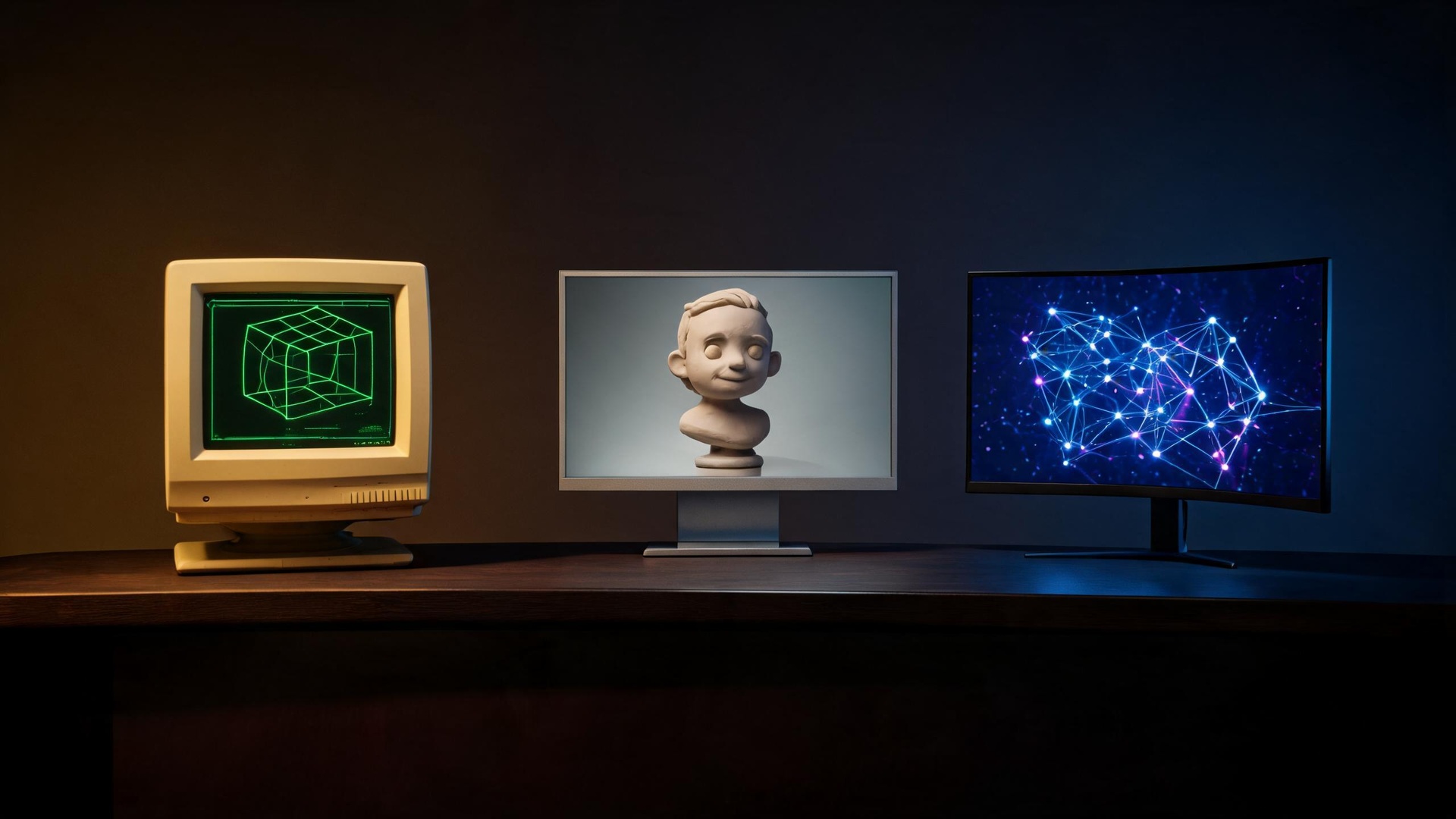
Toy Story released in 1995: the first fully computer-generated feature, 77 minutes, over 800 shots, averaging 15 hours per frame to render. The industry debated whether the technique could ever be practical. Thirty years later a laptop renders in minutes what took a day, and AI generates materials and drafts directly.
Era 1: Laboratory to screen (1972-1995)
3D graphics began in scientific visualization, not film. Catmull and Parke produced the first computer-animated face in 1972. ILM brought CG effects to features in the 1980s. Pixar formed in 1986. The bottleneck was pure compute: hours to tens of hours per frame meant short shots and simple geometry only.
Era 2: Rendering breakthroughs (1995-2005)
Ray tracing and global illumination made light behave physically. Subsurface scattering made skin, wax, milk and jade stop looking like plastic. Motion capture proved CG characters could carry performance. After this era, photorealistic delivery became a viable commercial standard and brands began replacing some live action with 3D.
Era 3: Industrial scale (2005-2018)
GPU rendering cut render times by an order of magnitude, putting commercial-grade product animation within reach of small studios. Blender matured as an open-source ecosystem, removing the licensing barrier and reshaping talent supply. PBR materials became portable across software. E-commerce demand for multi-angle product video created the batch 3D content category.
Era 4: AI (2018-present)
AI entered in waves: assisted modelling and texture generation, then generative imagery, then video models. Hybrid workflows are now mainstream — AI for materials, scene blocking and animation drafts; humans for precise modelling and final quality control. AI changes the distribution of effort, not the quality bar. Clients still require product appearance to match the physical item.
Three lessons
Technology advantages expire in two or three years; process advantages — storyboarding, asset libraries, color management — last a decade. Asset reuse is the underestimated moat. AI will not eliminate 3D artists; it will eliminate those who refuse to change their workflow.