
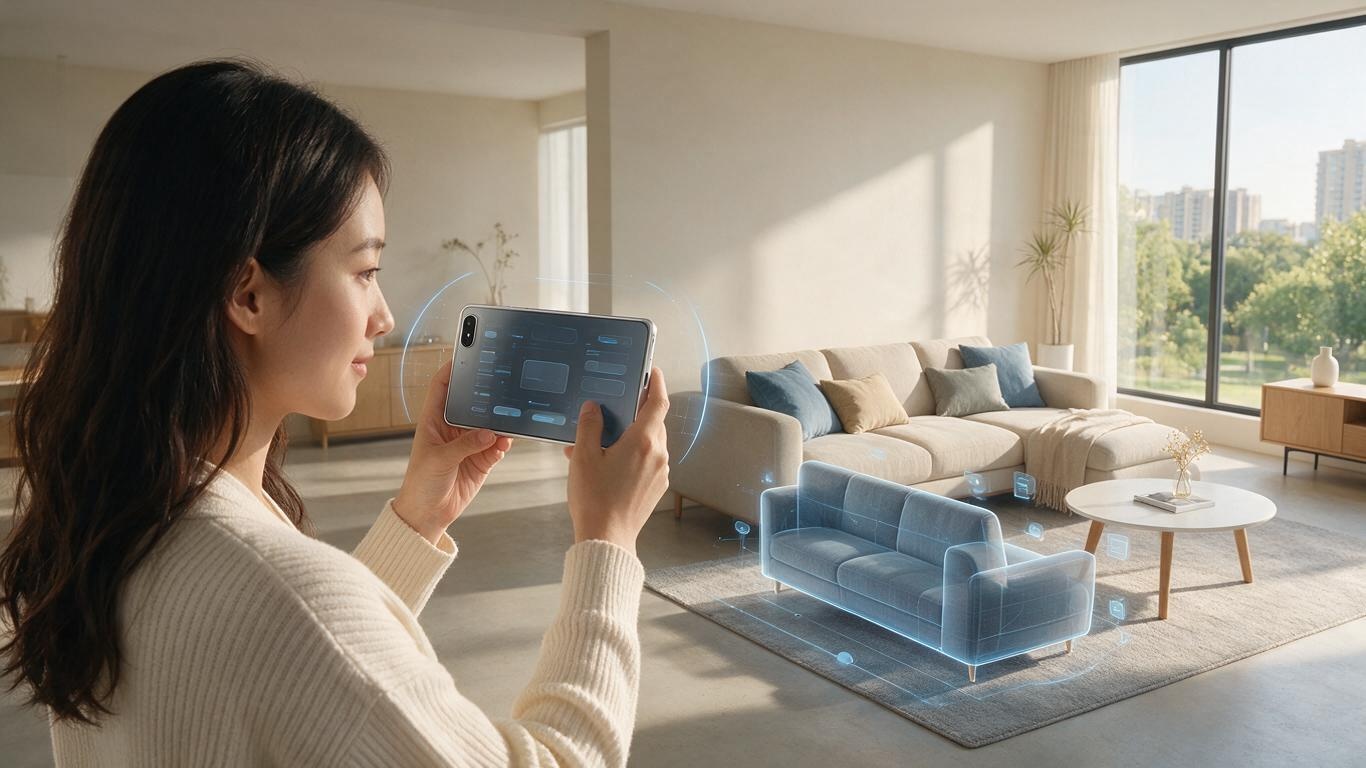
Have you ever scrolled through your phone and seen a sofa you love, but couldn't tell if it would actually fit in your living room? In 2026, AR shopping is solving exactly that — point your camera, and a virtual sofa appears in your space, with realistic size, fabric, and color.
This isn't science fiction. Our industry observations show that global AR shopping users have surpassed 400 million this year, and on major platforms like Amazon, Alibaba, and JD.com, the number of AR-enabled product listings has grown 210% year-over-year. Apple's AR Quick Look and Google's Scene Viewer are now standard smartphone features. Behind this wave lies a quiet but essential building block: 3D product showcase animation.
Why? Because AR shopping depends on rendering a believable 3D product in a real environment. That believability comes directly from the quality of the 3D model and the animation that brings it to life. When we say 3D product animation is the skeleton of AR, we mean it literally — the mesh is the bones, the animation is the muscle, and the materials and lighting are the skin. Miss any layer, and the illusion falls apart.
Compared to static images or even standard videos, interactive 3D lets consumers go from "looking at a product" to "experiencing it." Data shows that AR-enabled listings can lift conversion rates by over 30% in certain categories, while return rates drop noticeably. Furniture, beauty, and auto accessories — products where fit and finish matter — are natural fits for this interactive format. That's why more brands are building 3D assets as part of their long-term content strategy.
We previously discussed the evolution from live-action to AI+3D workflows, and it's exactly this trend in action. Instead of renting a studio and hiring models for every new angle, an AI-driven 3D pipeline lets you re-stage a product in any environment, material, or lighting scenario. Better yet, these 3D assets are the natural source for AR: the same animation you produce for product pages can be reused in AR shopping, virtual showrooms, and even metaverse experiences. One investment, multiple channels — that's the real ROI story for 2026.
Of course, AR shopping isn't universal yet. But neither was 4G in 2016. The technology inflection always arrives quietly. Recently, a client in the outdoor gear space told us they shifted their budget from conventional flat video to 3D product showcase animation. The reason: one model could serve AR, crowdfunding pages, their homepage, and even a digital wall at a trade show. One model, a thousand applications.
If your product visuals are still built entirely around traditional shooting, it's worth asking a new question: does your product have a 3D model that can enter an AR scene? If not, starting that process now might put you right on the edge of the next traffic surge. 3D product showcase animation is no longer a matter of "whether" but "how soon and how deep."